
Why Movements Matter
A watch’s “movement” is its engine—the mechanism that turns energy into steadily advancing hands. Choosing a movement type affects maintenance, accuracy, cost, and even how emotionally connected you’ll feel to the piece. Let’s break down the three classics you’ll see in most spec sheets.
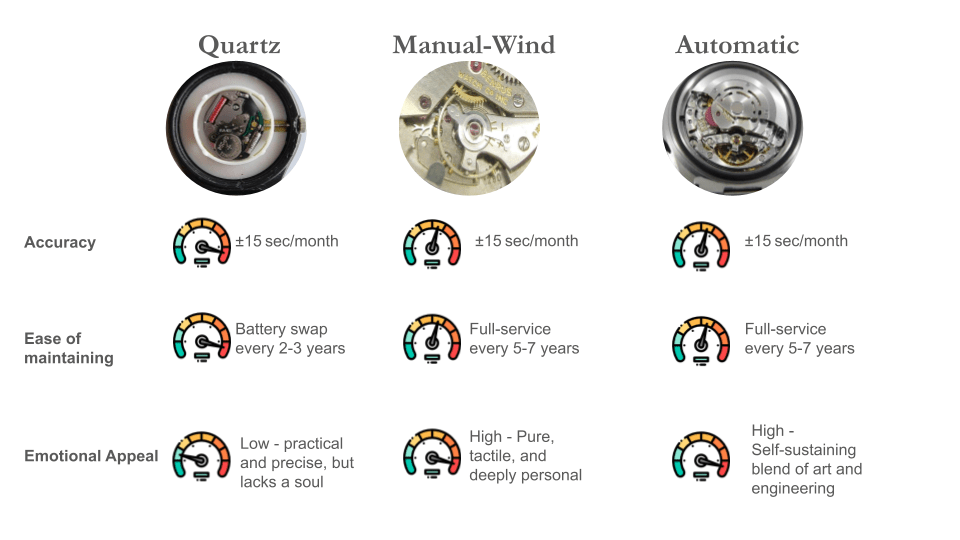
Quartz: The Battery‑Powered Workhorse

How it works: A tiny battery sends electricity through a quartz crystal. The crystal vibrates at 32,768 Hz; an integrated circuit counts those vibrations and drives an ultra‑efficient step‑per‑second motor.
Pros
- Top‑tier accuracy: You’ll lose or gain only a few seconds a month.
- Low maintenance: Swap a $5 battery every couple of years—done.
- Slim & affordable: Fewer gears mean thinner cases and lower prices.
Cons
- Disposable vibe: Many quartz modules are cheaper to replace than repair.
- Less romance: No sweeping seconds hand, no visible mechanics for enthusiasts to drool over (unless you spring for high‑end Spring Drive or thermo‑compensated quartz).
Best for: Anyone who wants grab‑and‑go reliability, travel watches, tool watches, or a low‑cost entry to the hobby.
Mechanical (Manual‑Wind): Old‑School Charm

How it works: You turn the crown; that winds a mainspring. As the spring unwinds, gears and an escapement regulate the release of energy, advancing the hands six or eight times per second.
Pros
- Tactile ritual: Daily winding builds a personal connection.
- Display‑case sex appeal: Visible gears and a smooth(ish) sweep.
- No batteries to die mid‑meeting.
Cons
- Less accurate: Expect ±20‑30 sec/day unless it’s COSC‑certified.
- Needs love: A full strip‑down and oiling every 5–7 years keeps it healthy.
- Power‑reserve anxiety: Forget to wind and it stops.
Best for: Purists who value heritage and don’t mind a quick morning wind‑up.
Automatic (Self‑Winding): Mechanical Convenience

How it works: A pivoting metal rotor spins with wrist movement, winding the mainspring automatically. Inside, it’s 95 % the same as a manual—plus the rotor and a reversing gear train.
Pros
- Set it and wear it: Your motion keeps it running.
- Same visceral sweep and craftsmanship as manual.
- Many options under $500 thanks to workhorse movements like Seiko NH35, Miyota 8xxx, or ETA 2824 clones.
Cons
- Still mechanical accuracy limits: ±15‑25 sec/day on average.
- Thickness & cost: Rotor stack adds height and complexity.
- Not truly grab‑and‑go: If it sits in a drawer for a couple of days, you’ll reset time and date.
Best for: Daily wearers who crave mechanical soul without daily winding.
Which One Should You Buy?
- First watch / everyday beater?
Grab a reliable quartz (e.g., Citizen Eco‑Drive, Casio G‑Shock). Zero fuss. - Looking for horological art?
Manual‑wind dress watches like the Hamilton Khaki Mechanical or a vintage Omega Cal. 30T2 whisper “watch‑nerd” without words. - One‑watch collection?
A robust automatic diver (think Seiko 5 SKX‑style or Formex Essence) balances romance and practicality.
Final Thoughts (and a 30‑Second Nerd Flex)
Quartz watches didn’t just disrupt the industry – they redefined it. With their unmatched accuracy, low maintenance, and rugged build, they became the default choice for anyone who valued function over flair. That’s why Bill Gates wears a $50 Casio – it’s a nod to practicality in a world obsessed with status. On the flip side, the resurgence of mechanical watches proves the art of watchmaking isn’t going anywhere. It’s a testament to what coils, gears, and balance springs can achieve when engineering meets artistry.
Know the difference, appreciate the craft, and choose what ticks for you.
Stay ticking—see you in the next post!
 Mechanical Minutes


.jpg)
Leave a comment