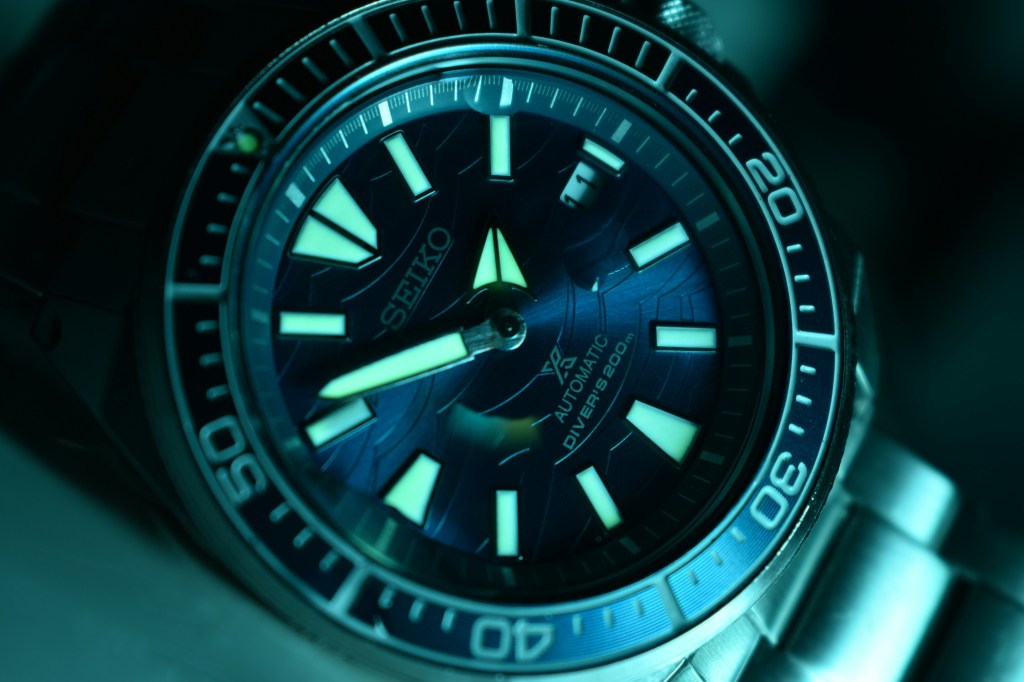
Nothing kills the romance of a diver quicker than a dial that vanishes at dusk. Let’s make sure yours doesn’t.
What Exactly Is “Lume”?
Lume is any luminous compound applied to a watch’s hands, indices, or bezel so the wearer can read time in the dark. Modern formulas are either self-charging phosphorescent paints (e.g., Super-LumiNova, LumiBrite) or tiny sealed tritium gas tubes that glow continuously through beta decay.

A Two-Minute History Lesson
- Radium paint (1910s-1960s) – radioactive, banned for safety.
- Tritium paint (1960s-1990s) – less radioactive but still regulated.
- Strontium-aluminate pigments (mid-1990s-today) – Super-LumiNova, LumiBrite; non-radioactive, recharge endlessly.
- Tritium gas tubes (1990s-today) – sealed H₃ vials, always “on,” half-life ≈ 12 years.

Meet the Major Players
| Family | Typical Color | Initial Brightness* | Fade Rate | Notable Brands |
|---|---|---|---|---|
| Tritium Gas Tubes | Green / Ice Blue | Up to 100× Super-LumiNova | Constant for ~10–12 yrs, then halves | BALL, MB-Microtec, Marathon |
| Super-LumiNova C3 | Pale green | 100 % baseline | Fastest first-hour fade | Most Swiss dive watches |
| Super-LumiNova BGW9 | Cool blue-white | 95 % | Slower fade than C3 | Omega, microbrands |
| Rolex Chromalight | Deep blue | ≈ 90 % | Very slow, 8-hr legibility | Rolex |
| Seiko LumiBrite Pro (2024) | Vivid green | Brighter & longer than prior LumiBrite | 3-5 hrs >10× old paints | Seiko Prospex Night Vision |
*Initial brightness relative to C3 baseline. Sources: manufacturer specs & 2024-25 field tests.
Brightness Showdown (Real-World)
- Tritium tubes win in absolute darkness—they never need charging and stay readable even after an all-night flight.
- C3 and LumiBrite Pro hit you with a “flashbulb” blast but taper off within the first hour.
- BGW9 & Chromalight glow softer yet hold useful legibility for 6-8 hours, which is why I trust my Datejust overnight.

Factors That Affect How Bright Your Watch Glows
- Pigment thickness & area – Thickly applied markers beat razor-thin dress-watch hands.
- Light source intensity & duration – UV-heavy LED flashlights top sunlight inside a window.
- Age & moisture – Even modern paints lose punch after decades; water ingress can kill lume entirely.
- Crystal tint & AR coatings – Blue AR can slightly cut green wavelengths.
Caring for Your Lume
Summarizing what I have learned based on endless browsing about lume:
- Give the dial a 30-second blast with a UV flashlight before night dives.
- Avoid prolonged temps > 60 °C; heat accelerates binder degradation.
- Service vintage tritium only with a qualified watchmaker; loose particles are mildly radioactive.
Key Takeaways
- Brightest on paper: Tritium gas tubes, but they dim only after a decade, not hours.
- Best all-rounder: BGW9 or Chromalight—pleasant hue, slower fade.
- New contender: Seiko’s LumiBrite Pro lifts traditional paint a notch closer to tritium territory.
 Mechanical Minutes
Leave a comment