
A natural follow‑up to Watch Movements 101 Pt 1 —this guide steps outside the movement to explore every visible (and a few hidden) components that make your watch look, feel, and perform the way it does.
1‑Minute Recap of Pt 1
In Watch Movements 101 Pt 1 we dug into the engine room—mainspring, gear train, escapement, balance wheel, and fine regulation.
Today we zoom out to the chassis and bodywork that protect and showcase that engine:
- Exterior architecture (crystal, bezel, crown, lugs, case)
- Protective hardware (gaskets, caseback, anti‑shock systems)
- Interface elements (dial, hands, lume, pushers, strap/bracelet & clasps)
- Supporting cast (jewels, rotor, bridges & plates—how they tie into the case)
Goal: After this 5‑7 minute read, you’ll glance at a watch and instantly recognize why every detail exists, not just what it is.
2. Surface Essentials—What You Touch & See First
2.1 Crystal

A watch crystal is the transparent shield that keeps dust, moisture, and a life of knocks away from the dial. The scratch resistance of watch crystal is measured using the Mohs scale, with 1 being the softest (for example, talc, which can be easily scratched using a fingernail) to the highest being 10 (diamond).
Commonly used materials:
• Sapphire (9 Mohs): Almost scratch‑proof; premium divers and luxury pieces.
• Mineral glass (≈5 Mohs): Hardened but affordable; easy to replace.
• Acrylic (≈3 Mohs): Vintage charm, cheap, can be polished; shatters less dangerously (no prickly shattered pieces).
2.2 Bezel

The bezel is the frame around the crystal. On tool watches it’s more than decoration:
- Diver’s bezel: Unidirectional count‑up for elapsed dive time.
- GMT bezel: 24‑hour scale for a second time‑zone.
- Tachymeter bezel: Fixed scale for speed = 3600 ÷ elapsed‑seconds.
2.3 Crown & Pushers

The crown is the command centre: wind, set, hack, or change modes. Screw‑down designs and twin gaskets safeguard water resistance.
Chronographs add pushers—plunger buttons—usually at 2 & 4 o’clock.
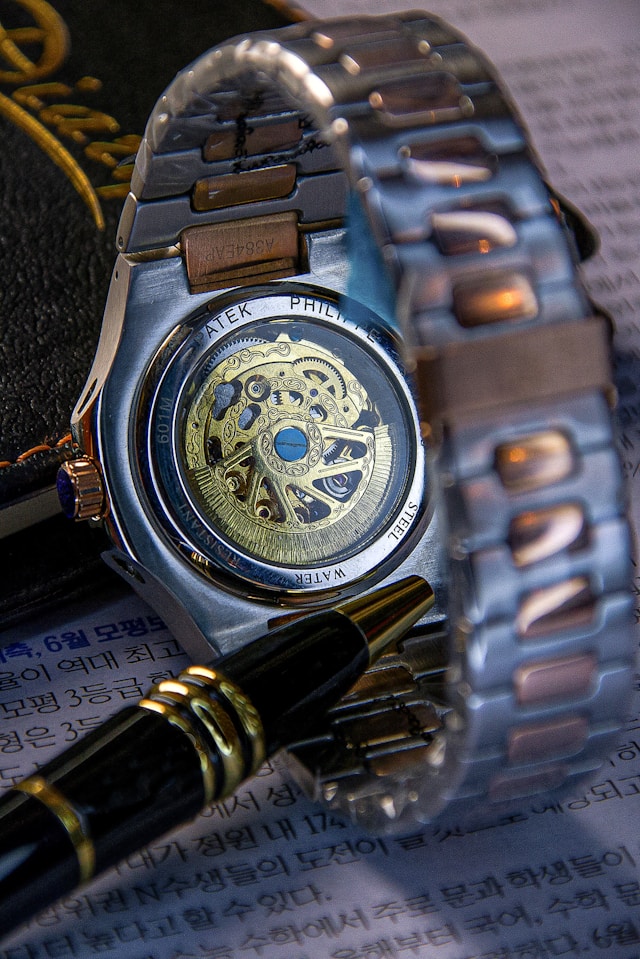
Photo by John Torcasio on Unsplash – Free to use.
2.4 Lugs & Spring Bars
Lugs are the horns that accept spring bars, letting straps swap easily. Shorter, downward‑curving lugs wear smaller; drilled lug holes speed up strap changes.

3. The Case—Guardian of the Movement
| Component | Role | Enthusiast Tips |
|---|---|---|
| Mid‑case | Main metal shell (steel, titanium, bronze). | Look for drilled lug holes & bevelled edges for comfort. |
| Caseback | Seals the movement. Solid backs allow engraving; sapphire display backs satisfy movement voyeurs. | Transparent backs add ≈1 mm thickness & can compromise magnetism shielding. |
| Gaskets | O‑rings of rubber or PTFE in crown, crystal, pushers, caseback. | Replace every 2–3 years if you swim frequently. |
| Helium Valve | Niche to saturation‑diving watches. | Useless to 99 % of wearers—consider it a flex. |
4. Dial & Hands—The Interface
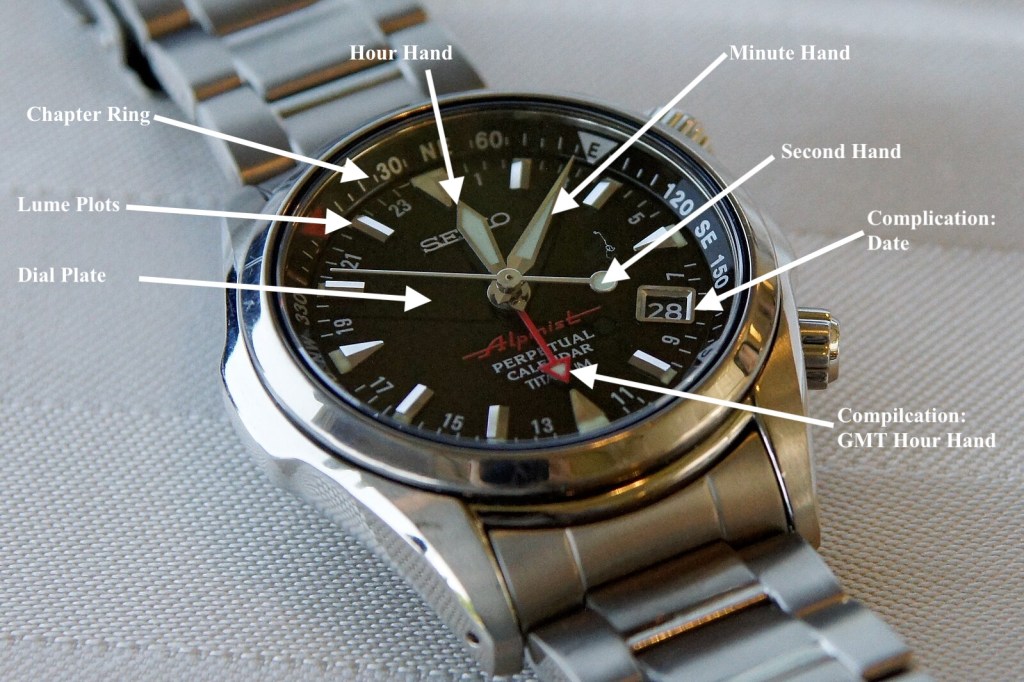
The dial is the face of the watch, where time is displayed and complications are showcased. It serves as the primary interface between the watch and its wearer, combining both function and style.
Dial Plate: The main surface of the dial, typically made from brass or German silver, then coated, printed, or enamelled for color and texture. This is where the hour markers, brand logo, and other visual elements are applied.
Hands: The moving pointers that indicate hours, minutes, and seconds. Often made from lightweight metal, they come in various shapes, from sword hands to dauphine or skeletonized designs.
Rehaut/Chapter Ring: The angled ring surrounding the dial, often used for minute tracks or depth markers. It provides a sense of depth to the watch and can be engraved or printed with additional markings. Read more here.
Lume Plots: Small, often raised dots or lines filled with luminous material like Super-LumiNova, designed to glow in the dark for improved legibility.
Complications: Additional functions beyond just displaying hours and minutes. Common examples include date windows, chronograph sub-dials, moon phase indicators, and power reserve meters.
5. Under‑The‑Hood Add‑Ons—Beyond the “101” Movement

While Movements 101 covered power, transmission, and regulation, three supporting parts deserve a cameo here:
- Rotor (automatic only): A semicircular weight that swings 360°, winding the mainspring in one or two directions. Adds about 1 mm height but saves you daily hand winding.
- Bridges & Plates: The movement’s “skeleton”—bridges hold gears; the main‑plate anchors everything. Haute horlogerie brands skeletonise bridges for art and weight savings. Read more here.
- Shock Protection (Incabloc/KIF): Spring‑mounted jewel settings let the balance staff flex during impact, boosting durability. Read more here.
6. Straps, Bracelets & Closures
- Bracelet (metal): Links + solid end links (SELs) + clasp. Look for screws, not friction pins.
- Strap (leather, rubber, fabric): Quick‑release spring bars are a boon for daily wearers.
- Clasp types: Tang buckle (traditional), deployant (folding), micro‑adjust clasp (on‑the‑fly comfort).
Hot‑take: A $20 well‑matched NATO strap can elevate a $500 micro‑brand better than a rattly stock bracelet.
7. Bringing It All Together—Why This Matters
Understanding the outer anatomy lets you:
- Diagnose: If your watch crystal fogs up, it’s not necessarily a movement issue—it’s more likely a gasket failure allowing moisture in. Knowing this saves you from unnecessary panic or costly movement repairs.
- Buy smarter: When buying a watch, it’s crucial to understand why certain features (like a ceramic bezel or a sapphire caseback) increase the price. It’s not just about aesthetics; these materials offer superior durability and scratch resistance, justifying the investment.
- Maintain: A gritty feeling when winding or setting your watch could indicate dirt or wear inside the screw-down crown tube. Getting it serviced early prevents water ingress, which could otherwise damage the movement you learned about earlier.
Your watch isn’t a black box; it’s an ecosystem where every screw and gasket plays its part. Recognise the synergy, and routine time‑checks become moments of appreciation.
Further Learning
🎥 Video pick: “A Complete Guide to the Parts of a Watch”
Just like the 101 part 1, I’m sharing a video to that helps you visualize the components that you just reviewed.
Share & Subscribe
If this deep dive made you look at your wrist differently, share the post and subscribe to Mechanical Minutes for more no‑nonsense horology every week.
Stay ticking!
 Mechanical Minutes

.jpg)

.jpg)