Tag: seiko

  • 5 Must-Have Watch Types for Collectors

    5 Must-Have Watch Types for Collectors

    Curating a watch collection isn’t just about owning expensive timepieces—it’s about building a personal horological narrative. Every watch should serve a purpose: some practical, others emotional. In this guide, I’ll share my approach to curating a 5-watch collection that blends daily utility, heirloom value, and collector’s curiosity. Whether you’re starting your journey or refining your rotation, this post might just help you find your own structure.


    🕰️ Category 1: The Daily Companion

    Watches that integrate into your everyday life — from meetings to meals, work to weekends.

    ⭐ Sinn 104 St Sa

    Sinn 104 with Psychology of Money in background

    My first serious mechanical watch, and still a favorite. The Sinn 104 strikes that rare balance between tool watch practicality and visual elegance. It’s robust, legible, and versatile enough to wear with a T-shirt or a blazer. It also holds sentimental value—a trait no spec sheet can quantify.

    🔑 Why this category matters: You’ll wear these the most. Prioritize comfort, brand reputation, durability, and emotional connection.


    🎩 Category 2: The Dress Watch

    Elegant timepieces reserved for moments that matter — weddings, celebrations, formal events.

    ⭐ Jaeger-LeCoultre Master Ultra Thin Moon

    Jager LeCoultre Master Ultra-Thin moon
    Buy JLC Master Ultra-Thin Moon on eBay

    dress watch is your horological black tie. The JLC Master Ultra-Thin Moon embodies everything a luxury formal piece should be: slim, sophisticated, and spellbinding under a cuff. The moonphase adds a poetic dimension without being ostentatious. Works equally well with a tux or a Nehru jacket.

    🔑 What to look for: Thin case, leather strap, timeless design, and finishing finesse. A complication like a moonphase or small seconds adds charm without clutter.


    🎨 Category 3: The Artistic Independent

    A wildcard — expressive, bold, and conversation-starting.
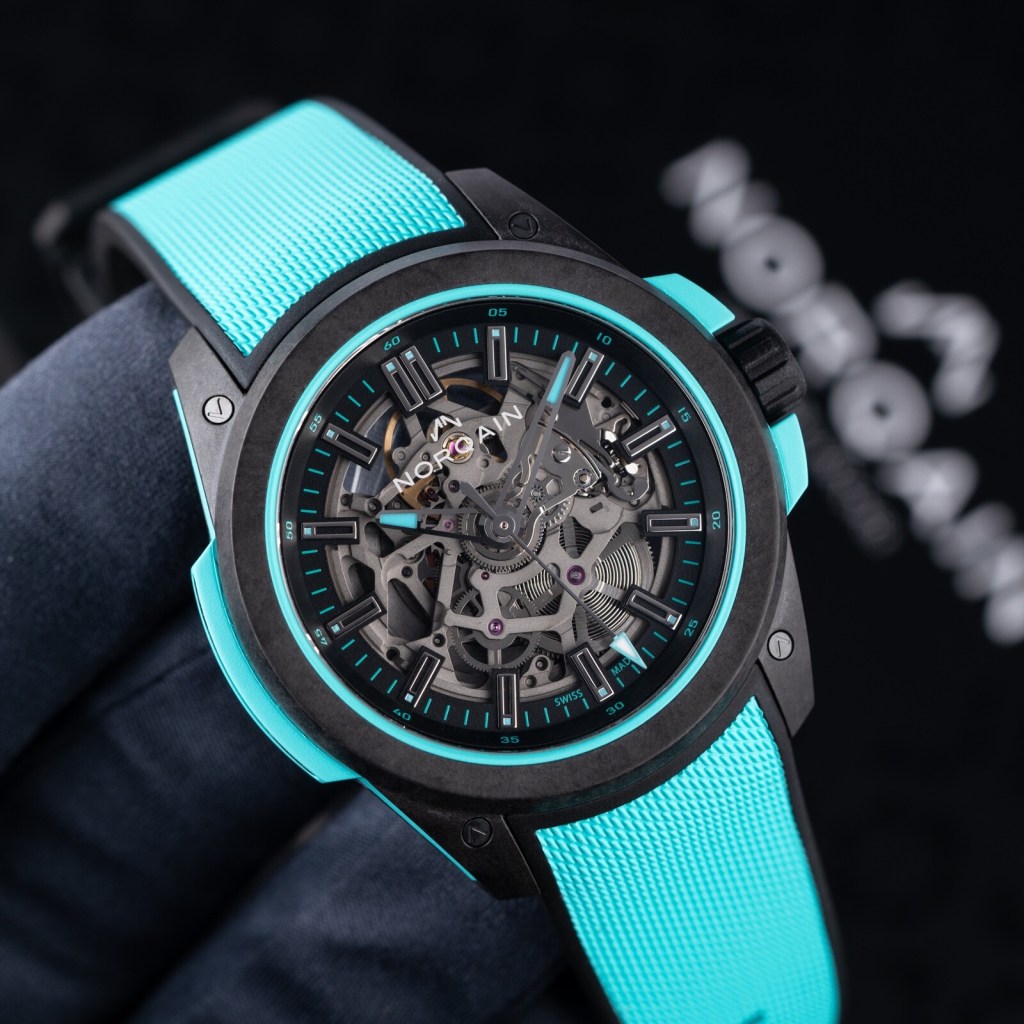
    Norqain Wild One on eBay
    Buy Norqain Wild One on eBay

    This category celebrates independent watchmaking and unique design language. These aren’t mainstream picks, but rather thoughtful pieces from niche houses pushing creative boundaries.

    🧭 Contenders:

    • BA111OD Chapter 5: Swiss ingenuity meets transparency—both in design and pricing.
    • Norqain Wild One: A rugged but refined indie sport watch with bold aesthetics.
    • Louis Erard x Alain Silberstein: Pure horological art. Colorful, expressive, and rare.
    • Ochs und Junior Moonphase: Minimalist, brainy, and handmade.
    • Ming 17.x or 27.x series: Ethereal case shapes and stunning dials that defy their price point.

    🔑 Why it matters: These watches reflect taste, curiosity, and support for the craft. They’re often limited and collectible.


    🛡️ Category 4: The Beater / Tool Watch

    Tough, affordable, mechanical watches that you can truly use.

    Every collection needs a watch you can knock around—without knocking your soul. Something you wear while traveling, hiking, swimming, or just doing life.

    ⭐ Seiko SRPK43

    Seiko SRPK43
    Buy Seiko SRPK43 on eBay

    A blackout beauty with great lume, reliable automatic movement, and serious wrist presence. The SRPK43 is a modern reinterpretation of the legendary SKX—tough, stylish, and under-the-radar.

    ⭐ Certina DS Action Diver

    Certina DS Action Diver
    Buy Certina DS Action Diver on eBay

    Swiss made, ISO-certified dive watch with a Powermatic 80 movement. It punches far above its price point in ruggedness and everyday appeal.

    🔑 Checklist for this slot: 200m+ water resistance, strong lume, shock resistance, and a price point that doesn’t sting when scratched.


    🧭 Category 5: The Legacy Piece

    A future heirloom—iconic, timeless, and emotionally significant.

    Though some watches already serve dual purposes (like the Datejust), this final category is about choosing a flagship piece that speaks to your identity and will outlive trends. For me, this overlaps with my daily wear, but for others, it could be a complication-rich chronograph, a GMT for a frequent traveler, or a vintage-inspired reissue.

    Think of this watch not just as a purchase, but as a story you’re writing for the next generation.

    ⭐ Rolex Datejust 36mm
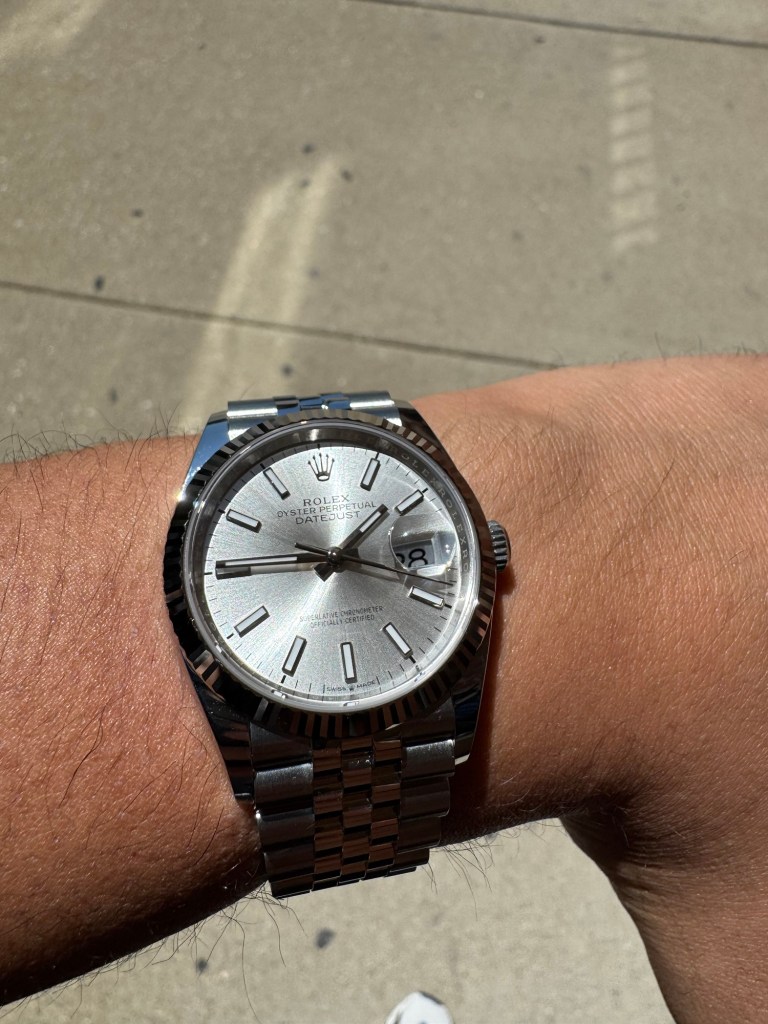
    Rolex Oyster Perpetual Datejust

    With the jubilee braceletfluted bezel, and timeless silver dial, the Rolex Datejust 36transcends trends. It’s a piece I can wear to work, weddings, or just lounging at home. More than a luxury item, it’s a future heirloom—like how my grandfather’s Rajat watch still echoes his presence.


    Final Thoughts: Don’t Chase, Curate

    Building a watch collection is a deeply personal journey. There’s no one right way to do it—but defining your own categories helps filter the noise. Watches aren’t just about specs—they’re about purpose, emotion, and presence. Buy slowly, wear often, and choose pieces that resonate with your life.

    📝 What’s your 5-watch dream collection? Drop a comment or check out more on MechanicalMinutes.com.

  • Understanding Watch Complications: A Quick Guide

    Understanding Watch Complications: A Quick Guide

    As soon as you start surfing Chrono24, Bob’s Watches, or binge-watching Teddy Baldassarre, one thing jumps out: watches do much more than tell time. From timing a lap to summoning the phases of the moon, each “function”—or complication—adds engineering flair, price, and bragging rights.

    Below is a lightning-round tour of ten of the most talked-about functions. For each one you’ll see how it workstypical price entry points, an iconic reference, and an affordable gateway piece (when one exists—some complications stay stubbornly expensive).

    FunctionWhat Makes It TickStarting Price1Iconic PieceAffordable Gateway
    Date / Day-DateA simple disk under the dial jumps once per day.≈ $150Rolex Day-Date (aka “President”)Seiko 5 Sports
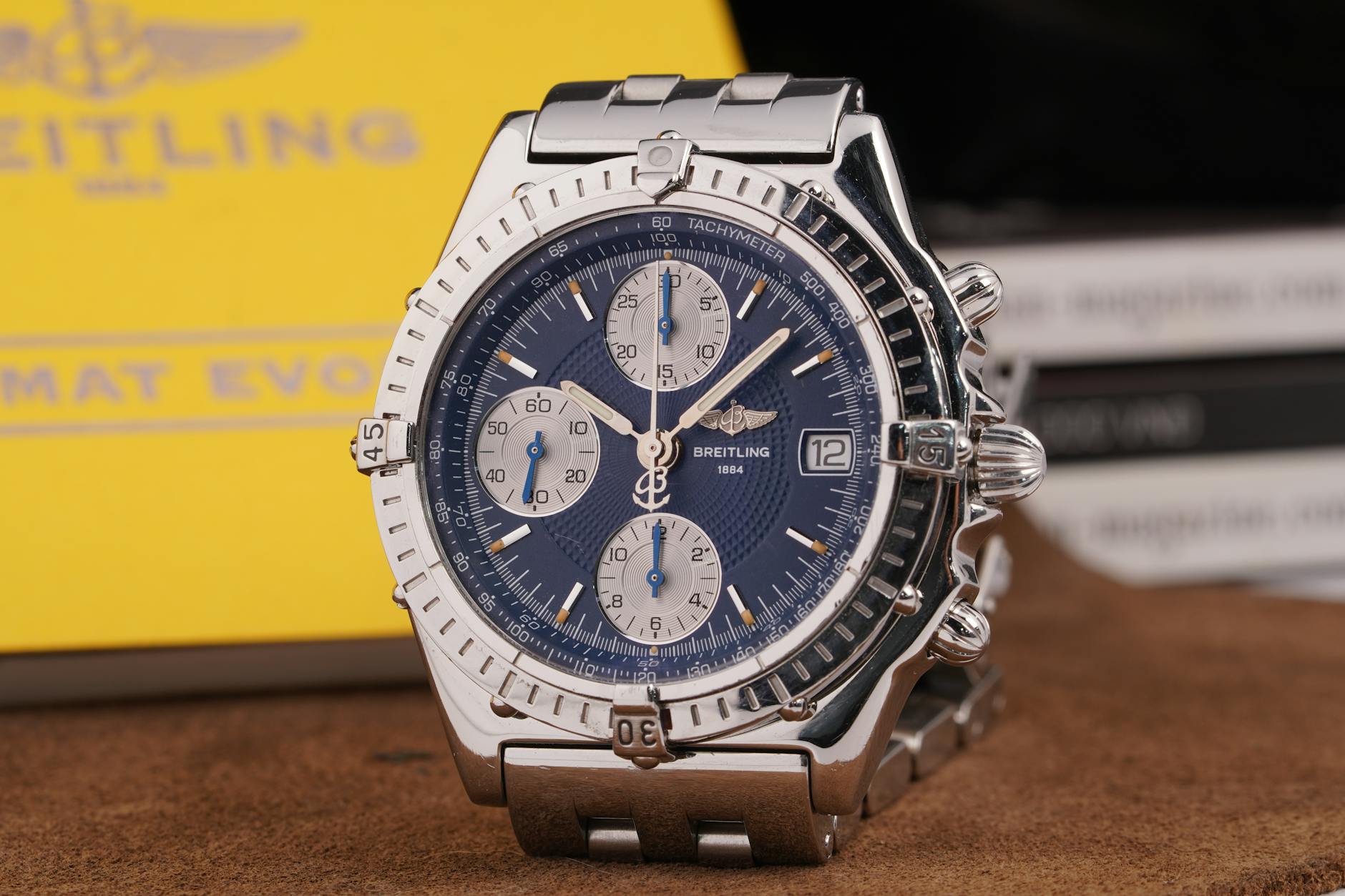
    ChronographStart/stop/reset cams2 & levers run a secondary gear-train to time events.≈ $250Omega Speedmaster “Moonwatch”Tissot PRX Chronograph
    GMT / Dual TimeA 24-hour hand geared to rotate once per day tracks a second zone.≈ $300Rolex GMT-Master II “Pepsi”Seiko 5 GMT (SSK series)
    AlarmA separate spring barrel drives a hammer that strikes an internal gong.≈ $600Jaeger-LeCoultre MemovoxSeiko “Bell-Matic” (vintage)
    Moon PhaseA 59-tooth disk advances once every 24 h to sync with the 29.5-day lunar cycle.≈ $300Patek Philippe 3940Orient Sun & Moon v4
    Tachymeter (with Chronograph)Fixed bezel or dial scale converts elapsed seconds into speed or rate.Chronograph pricingOmega SpeedmasterBulova Lunar Pilot
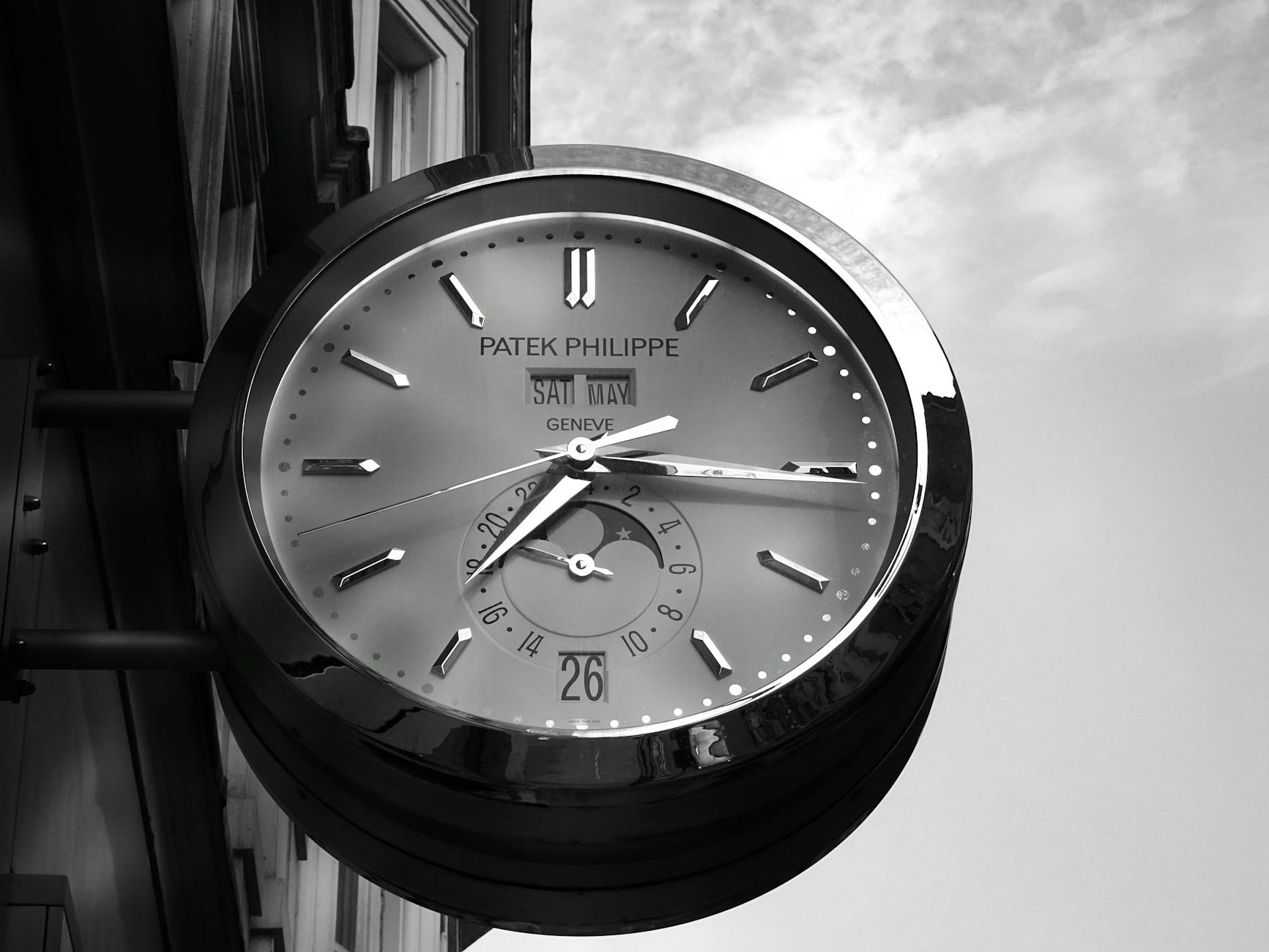
    Annual CalendarUses a cam programmed for 30-/31-day months; needs adjustment only on Feb 28/29.≈ $3 000Patek Philippe 5035 (first ever)Longines Master Collection Moonphase Retrograde Annual Calendar
    Perpetual CalendarLever “memory” accounts for leap years—no correction until 2100.≈ $6 000 (used)Audemars Piguet Royal Oak PerpetualNone—high-horology only
    Flyback ChronographClutch lets you reset & restart timing with one press—perfect for pilots.≈ $1400Breguet Type XXBaltic Bicompax “Panda”
    TourbillonThe entire escapement spins in a cage each minute to average out positional errors.≈ $500 (Chinese brands)Breguet Classique 5317Seagull ST8000 tourbillon

    Bite-Size Deep-Dives


    1. Date / Day-Date

    Photo by Arjunn. la on Pexels.com
    • Why it matters: Everyday convenience.
    • Geek fact: Rolex’s 1945 Datejust was the first self-winding wristwatch with an instantaneous date jump; the “quick-set” feature didn’t appear until 1977.

    2. Chronograph

    Photo by Quang Viet Nguyen on Pexels.com
    • Why it matters: Lap timing + tactile pusher feel.
    • Geek fact: Vertical-clutch chronographs (e.g., Seiko 6139, Zenith El Primero) let the seconds hand run continuously with virtually no amplitude loss—perfect for OCD accuracy nerds.

    3. GMT / Dual Time

    Photo by Bhop Phikanesuan on Pexels.com
    • Why it matters: Track two zones at once.
    • Geek fact: The Rolex 6542 “Pepsi” (1954) was developed for Pan Am pilots; its original Bakelite bezel was so fragile many were swapped for aluminum—surviving Bakelite models fetch six-figure sums.

    4. Alarm

    Seiko Bell-Matic 17 Jewels, via Wikimedia Commons, licensed under CC BY-SA 3.0 AT.
    • Why it matters: A mechanical ringtone on your wrist.
    • Geek fact: The Vulcain “Cricket” was nicknamed The President’s Watch—Truman, Eisenhower, Nixon and Johnson all wore one in the Oval Office.

    5. Moon Phase

    Photo by SevenStorm JUHASZIMRUS on Pexels.com
    • Why it matters: Pure romance.
    • Geek fact: A 135-tooth moon-phase disk (e.g., H. Moser Endeavour) drifts by one day every 122 years—over 4 × more accurate than the traditional 59-tooth setup.

    6. Tachymeter (w/ Chronograph)

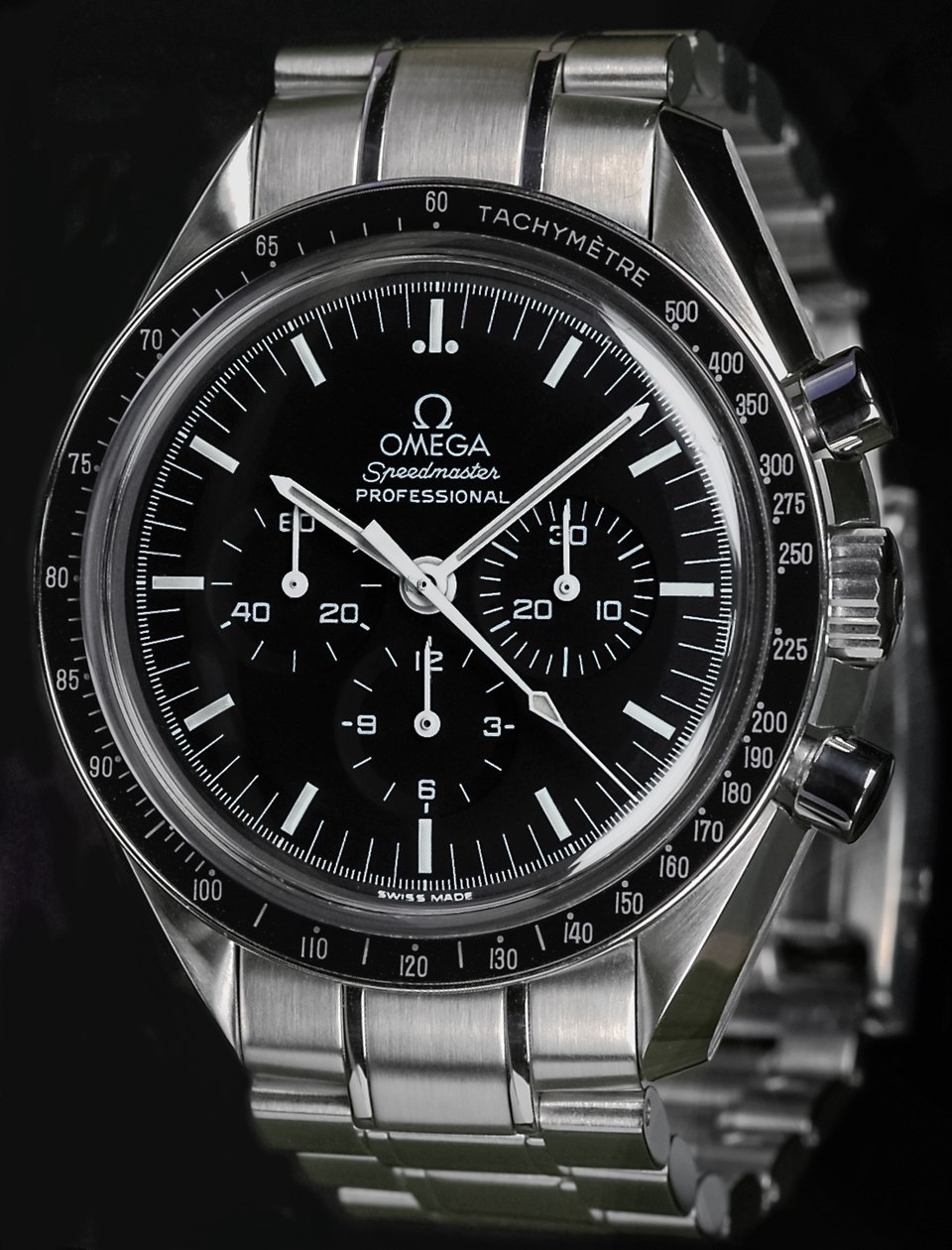
    Omega Speedmaster Professional, via Wikimedia Commons, released into the public domain by the author, Torsten Bolten.
    • Why it matters: Converts elapsed time into speed or rate.
    • Geek fact: You can flip the script—time one unit of production (say, wrapping a burrito) and the tachy scale shows burritos per hour. Fast-food nerd badge unlocked.

    7. Annual Calendar

    Jaeger-LeCoultre Master Calendar in Stainless Steel (Ref. Q151842A), via Wikimedia Commons, licensed under CC BY-SA 4.0.
    • Why it matters: Adjust once a year, not every month.
    • Geek fact: Patek Philippe created the complication only in 1996 (Ref 5035); they patented the three-cam mechanism that became the modern template.

    8. Perpetual Calendar

    Audemars Piguet Royal Oak Perpetual Calendar in Gold, mid-1990s, via Wikimedia Commons, licensed under CC BY-SA 4.0.
    • Why it matters: No correction until 2100.
    • Geek fact: Patek’s 1925 Ref 97975 was the first wrist-perpetual; its 48-month “leap-year cam” makes just one full rotation every 4 years.

    9. Flyback Chronograph

    Breguet Watch, via Wikimedia Commons, licensed under CC BY-SA 3.0.
    • Why it matters: Reset & restart with one push—ideal for navigation legs.
    • Geek fact: The Breguet Type 20 spec demanded the movement reset within 0.2 seconds—a quality-control test still enforced on modern Type XX models.

    10. Tourbillon

    Greubel Forsey Tourbillon 24 Secondes Incliné, via Wikimedia Commons, licensed under CC BY-SA 3.0.

    Geek fact: The original 1801 Breguet patent was for pocket watches; multi-axis tourbillons (e.g., Jaeger-LeCoultre Gyrotourbillon) compound the effect by spinning on two or three perpendicular axes.

    Why it matters: Rotating escapement eye-candy.


    Wrapping Up

    Complications add personality and engineering theater. Whether you’re timing a marathon or admiring a miniature lunar cycle, knowing why a function exists helps you decide if the extra cost (and service complexity) is worth it.


    Stay ticking!


    1. Typical street prices for stainless-steel pieces, new unless noted. Prices vary significantly based on brand, movement type, materials, and market demand. ↩︎
    2. Cams in watchmaking are specially shaped mechanical components that convert rotary motion into linear or intermittent movement. They are a critical part of many watch complications, particularly chronographs, where they help coordinate the start, stop, and reset actions. ↩︎

    Share & Subscribe

    If this deep dive made you look at your wrist differently, share the post and subscribe to Mechanical Minutes for more no‑nonsense horology every week.

  • Watch Parts 101 – Pt 2

    Watch Parts 101 – Pt 2

    A natural follow‑up to Watch Movements 101 Pt 1 —this guide steps outside the movement to explore every visible (and a few hidden) components that make your watch look, feel, and perform the way it does.


    1‑Minute Recap of Pt 1

    In Watch Movements 101 Pt 1 we dug into the engine room—mainspring, gear train, escapement, balance wheel, and fine regulation.
    Today we zoom out to the chassis and bodywork that protect and showcase that engine:

    • Exterior architecture (crystal, bezel, crown, lugs, case)
    • Protective hardware (gaskets, caseback, anti‑shock systems)
    • Interface elements (dial, hands, lume, pushers, strap/bracelet & clasps)
    • Supporting cast (jewels, rotor, bridges & plates—how they tie into the case)

    Goal: After this 5‑7 minute read, you’ll glance at a watch and instantly recognize why every detail exists, not just what it is.


    2. Surface Essentials—What You Touch & See First

    2.1 Crystal

    Close-up of a watch face with droplets of water on a dark blue dial, showcasing the hour markers and hands.

    A watch crystal is the transparent shield that keeps dust, moisture, and a life of knocks away from the dial. The scratch resistance of watch crystal is measured using the Mohs scale, with 1 being the softest (for example, talc, which can be easily scratched using a fingernail) to the highest being 10 (diamond).
    Commonly used materials:
    • Sapphire (9 Mohs): Almost scratch‑proof; premium divers and luxury pieces.
    • Mineral glass (≈5 Mohs): Hardened but affordable; easy to replace.
    • Acrylic (≈3 Mohs): Vintage charm, cheap, can be polished; shatters less dangerously (no prickly shattered pieces).

    2.2 Bezel

    Close-up of a watch featuring a tachymeter scale, with a white dial, black and silver accents, and a chronograph sub-dial.
    Tachymeter Bezel Detail, via Wikimedia Commons, licensed under CC BY-SA 3.0.

    The bezel is the frame around the crystal. On tool watches it’s more than decoration:

    • Diver’s bezel: Unidirectional count‑up for elapsed dive time.
    • GMT bezel: 24‑hour scale for a second time‑zone.
    • Tachymeter bezel: Fixed scale for speed = 3600 ÷ elapsed‑seconds.

    2.3 Crown & Pushers

    Close-up of a watch showcasing the dial, with prominent hour markers and a textured crown with a distinct emblem.
    Crown and chronograph pushers of a Montblanc Timewalker, via Wikimedia Commons, licensed under CC BY-SA 4.0.

    The crown is the command centre: wind, set, hack, or change modes. Screw‑down designs and twin gaskets safeguard water resistance.
    Chronographs add pushers—plunger buttons—usually at 2 & 4 o’clock.
    Photo by John Torcasio on Unsplash – Free to use.

    2.4 Lugs & Spring Bars

    Lugs are the horns that accept spring bars, letting straps swap easily. Shorter, downward‑curving lugs wear smaller; drilled lug holes speed up strap changes.

    Close-up view of a watch case back featuring a sapphire crystal, with engraved markings indicating water resistance and materials, alongside a beige leather strap.

    3. The Case—Guardian of the Movement

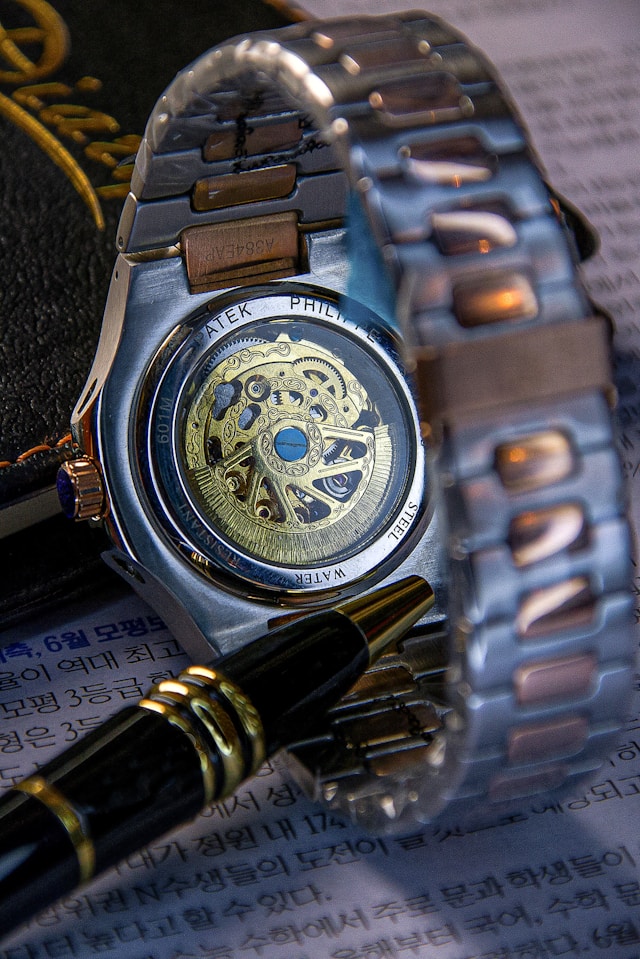
    Close-up of a Patek Philippe showing its intricate movement through a transparent caseback, surrounded by a silver metal bracelet and a black pen resting on paper with text.
    Photo showing the caseback by Hammad Zaheer on Unsplash
    ComponentRoleEnthusiast Tips
    Mid‑caseMain metal shell (steel, titanium, bronze).Look for drilled lug holes & bevelled edges for comfort.
    CasebackSeals the movement. Solid backs allow engraving; sapphire display backs satisfy movement voyeurs.Transparent backs add ≈1 mm thickness & can compromise magnetism shielding.
    GasketsO‑rings of rubber or PTFE in crown, crystal, pushers, caseback.Replace every 2–3 years if you swim frequently.
    Helium ValveNiche to saturation‑diving watches.Useless to 99 % of wearers—consider it a flex.


    4. Dial & Hands—The Interface

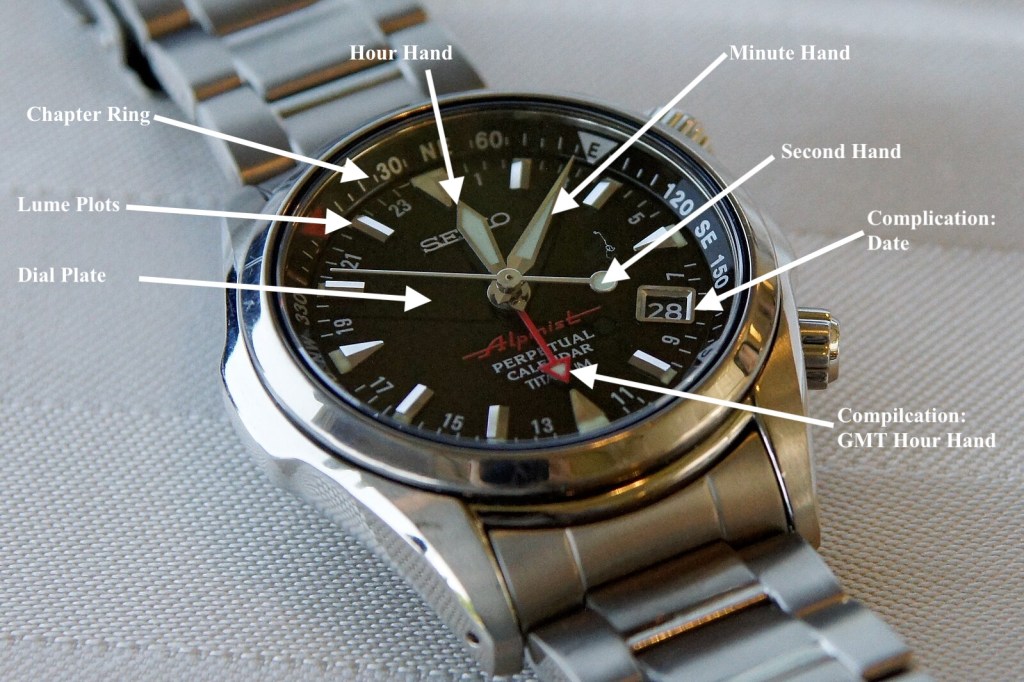
    Close-up of a watch face displaying hour, minute, and second hands, along with features like lume plots, dial plate, chapter ring, and complications such as date and GMT hour hand.
    Modified from “Seiko Prospex Alpinist,” via Wikimedia Commons, licensed under CC BY-SA 4.0.

    The dial is the face of the watch, where time is displayed and complications are showcased. It serves as the primary interface between the watch and its wearer, combining both function and style.

    Dial Plate: The main surface of the dial, typically made from brass or German silver, then coated, printed, or enamelled for color and texture. This is where the hour markers, brand logo, and other visual elements are applied.

    Hands: The moving pointers that indicate hours, minutes, and seconds. Often made from lightweight metal, they come in various shapes, from sword hands to dauphine or skeletonized designs.

    Rehaut/Chapter Ring: The angled ring surrounding the dial, often used for minute tracks or depth markers. It provides a sense of depth to the watch and can be engraved or printed with additional markings. Read more here.

    Lume Plots: Small, often raised dots or lines filled with luminous material like Super-LumiNova, designed to glow in the dark for improved legibility.

    Complications: Additional functions beyond just displaying hours and minutes. Common examples include date windows, chronograph sub-dials, moon phase indicators, and power reserve meters.


    5. Under‑The‑Hood Add‑Ons—Beyond the “101” Movement

    Close-up image of a watch movement showcasing intricate gears and a gold-plated rotor labeled 'Stowa Twenty-Five 25 Jewels Swiss Made'.
    ETA 2824 movement, via Wikimedia Commons, licensed under CC BY-SA 2.0.

    While Movements 101 covered power, transmission, and regulation, three supporting parts deserve a cameo here:

    1. Rotor (automatic only): A semicircular weight that swings 360°, winding the mainspring in one or two directions. Adds about 1 mm height but saves you daily hand winding.
    2. Bridges & Plates: The movement’s “skeleton”—bridges hold gears; the main‑plate anchors everything. Haute horlogerie brands skeletonise bridges for art and weight savings. Read more here.
    3. Shock Protection (Incabloc/KIF): Spring‑mounted jewel settings let the balance staff flex during impact, boosting durability. Read more here.


    6. Straps, Bracelets & Closures

    • Bracelet (metal): Links + solid end links (SELs) + clasp. Look for screws, not friction pins.
    • Strap (leather, rubber, fabric): Quick‑release spring bars are a boon for daily wearers.
    • Clasp types: Tang buckle (traditional), deployant (folding), micro‑adjust clasp (on‑the‑fly comfort).

    Hot‑take: A $20 well‑matched NATO strap can elevate a $500 micro‑brand better than a rattly stock bracelet.


    7. Bringing It All Together—Why This Matters

    Understanding the outer anatomy lets you:

    1. Diagnose: If your watch crystal fogs up, it’s not necessarily a movement issue—it’s more likely a gasket failure allowing moisture in. Knowing this saves you from unnecessary panic or costly movement repairs.
    2. Buy smarter: When buying a watch, it’s crucial to understand why certain features (like a ceramic bezel or a sapphire caseback) increase the price. It’s not just about aesthetics; these materials offer superior durability and scratch resistance, justifying the investment.
    3. Maintain: A gritty feeling when winding or setting your watch could indicate dirt or wear inside the screw-down crown tube. Getting it serviced early prevents water ingress, which could otherwise damage the movement you learned about earlier.

    Your watch isn’t a black box; it’s an ecosystem where every screw and gasket plays its part. Recognise the synergy, and routine time‑checks become moments of appreciation.


    Further Learning

    🎥 Video pick: “A Complete Guide to the Parts of a Watch

    Just like the 101 part 1, I’m sharing a video to that helps you visualize the components that you just reviewed.


    Share & Subscribe

    If this deep dive made you look at your wrist differently, share the post and subscribe to Mechanical Minutes for more no‑nonsense horology every week.


    Stay ticking!