Tag: timepieces

  • Watch Anatomy 101 – Pt 1

    Watch Anatomy 101 – Pt 1

    Understanding the Heartbeat of Your Timepiece
    A deeper dive into escapements, balance wheels, and the magic behind precise time-keeping.


    1. Power & Transmission – Mainspring → Gear-Train

    Close-up of a watch movement showcasing gears, jewels, and mechanical components that contribute to the timekeeping mechanism.
    Photo from Unsplash, free to use.
    1. Mainspring barrel: wound manually or by a rotor; typical torque ~5 mN mm.
    2. Gear train: steps the mainspring’s ±2 rpm down to one revolution/hour at the minute hand.
    3. Jewels: synthetic rubies that slash friction at pivot points.

    2. Escapement – Where the Magic Happens

    Diagram illustrating the escapement mechanism of a watch, showing components like the balance wheel, pallet fork, and escape wheel.
    Lever Escapement Diagram, via Wikimedia Commons, licensed under CC BY-SA 3.0.
    EscapementHow it worksProsCons
    Swiss Lever (industry work-horse)Pallet fork locks & unlocks escape wheel in sync with balance wheel.Robust, easy to service.Sliding friction → need for lubrication.
    Co-Axial (Omega)Adds a secondary wheel so force is radial, not sliding.Less lubricant, longer service.Costly to machine; thicker.
    High-Beat (e.g., Grand Seiko 36 000 vph)Same lever system, just faster beats.Smoother seconds hand, better positional stability.Higher wear, lower power-reserve.
    Exotics (detent, constant-force, remontoir)Niche, often for chronometry contests.Chronograph-grade accuracy.Fragile, expensive, rarely serviceable.

    3. Balance Wheel & Hairspring – The Watch’s “Pendulum”

    Close-up view of a watch movement showcasing the balance wheel, escapement, and synthetic rubies used at pivot points.
    Benrus Watch Balance Wheel, via Wikimedia Commons, public domain.
    • Balance wheel: typically Glucydur—beryllium/bronze for temp stability.
    • Hairspring: Nivarox, silicon, or Parachrom. Regulates the restoring force.
    • Frequency: 18 000 vph (2.5 Hz) up to 36 000 vph (5 Hz). Faster = smoother seconds hand
    • Adjustments: Chronometer-grade movements are adjusted in multiple positions & temperatures.

    4. Fine Regulation

    TermWhat it meansHow to spot it
    Beat errorTime difference between clockwise & counter-clockwise swings.< 0.6 ms on a time-grapher = healthy.
    AmplitudeDegrees the balance rotates.270°–310° dial-up; below 220° signals service.
    IsochronismRate stays constant as mainspring unwinds.Achieved via better alloys, free-sprung balances, or constant-force devices.

    5. Finishing & Practical Considerations

    A close-up view of a sophisticated Omega Seamaster featuring a blue dial, silver stainless steel case, and chronograph sub-dials.
    Photo by John Torcasio on Unsplash – Free to use.
    • Geneva stripes, perlage, anglage – purely decorative, but show brand effort.
    • Service intervals – every 5–7 yrs for a daily-wear Swiss-lever; 8–10 yrs for Co-Axial.
    • Water-resistance checks – gaskets age faster than oils; pressure-test annually if you swim with the watch.

    Key Take-aways for Enthusiasts

    1. Escapement type & beat-rate drive real-world accuracy.
    2. Finishing ≠ timekeeping – admire it, but assess regulation specs first.
    3. Ask for a time-grapher print-out when buying vintage; amplitude & beat-error reveal health better than dial cosmetics.
    4. Service history matters more than brand hype for long-term reliability.

    📹 Quick Watch: Understanding Watch Anatomy

    More of a visual learner? I get it. This quick watch (pun intended) covers the core concepts from this post, perfect for absorbing the details in a few minutes.

    Stay ticking!


  • Mechanical vs. Quartz vs. Automatic—A 5‑Minute Primer

    Mechanical vs. Quartz vs. Automatic—A 5‑Minute Primer

    Why Movements Matter

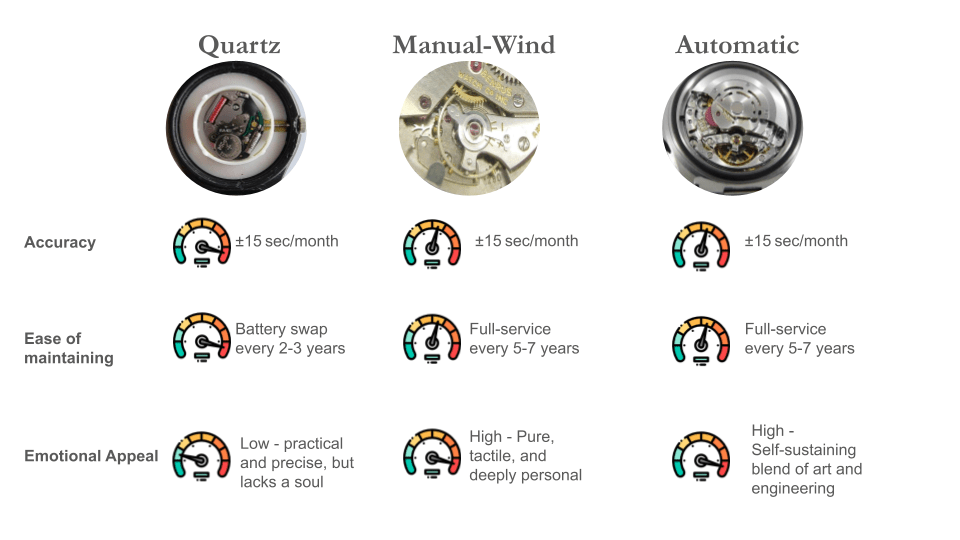
    A watch’s “movement” is its engine—the mechanism that turns energy into steadily advancing hands. Choosing a movement type affects maintenance, accuracy, cost, and even how emotionally connected you’ll feel to the piece. Let’s break down the three classics you’ll see in most spec sheets.


    Quartz: The Battery‑Powered Workhorse

    Seiko Quartz A.G.S. Perpetuum Nobile, via Wikimedia Commons, licensed under CC BY-SA 4.0.

    How it works: A tiny battery sends electricity through a quartz crystal. The crystal vibrates at 32,768 Hz; an integrated circuit counts those vibrations and drives an ultra‑efficient step‑per‑second motor.

    Pros

    • Top‑tier accuracy: You’ll lose or gain only a few seconds a month.
    • Low maintenance: Swap a $5 battery every couple of years—done.
    • Slim & affordable: Fewer gears mean thinner cases and lower prices.

    Cons

    • Disposable vibe: Many quartz modules are cheaper to replace than repair.
    • Less romance: No sweeping seconds hand, no visible mechanics for enthusiasts to drool over (unless you spring for high‑end Spring Drive or thermo‑compensated quartz).

    Best for: Anyone who wants grab‑and‑go reliability, travel watches, tool watches, or a low‑cost entry to the hobby.


    Mechanical (Manual‑Wind): Old‑School Charm

    Nomos Glashütte Metro, via Wikimedia Commons, licensed under CC BY-SA 4.0.

    How it works: You turn the crown; that winds a mainspring. As the spring unwinds, gears and an escapement regulate the release of energy, advancing the hands six or eight times per second.

    Pros

    • Tactile ritual: Daily winding builds a personal connection.
    • Display‑case sex appeal: Visible gears and a smooth(ish) sweep.
    • No batteries to die mid‑meeting.

    Cons

    • Less accurate: Expect ±20‑30 sec/day unless it’s COSC‑certified.
    • Needs love: A full strip‑down and oiling every 5–7 years keeps it healthy.
    • Power‑reserve anxiety: Forget to wind and it stops.

    Best for: Purists who value heritage and don’t mind a quick morning wind‑up.


    Automatic (Self‑Winding): Mechanical Convenience

    Avro CF105 Arrow Pilot Watch by WWCo., via Wikimedia Commons, licensed under CC BY-SA 4.0.

    How it works: A pivoting metal rotor spins with wrist movement, winding the mainspring automatically. Inside, it’s 95 % the same as a manual—plus the rotor and a reversing gear train.

    Pros

    • Set it and wear it: Your motion keeps it running.
    • Same visceral sweep and craftsmanship as manual.
    • Many options under $500 thanks to workhorse movements like Seiko NH35, Miyota 8xxx, or ETA 2824 clones.

    Cons

    • Still mechanical accuracy limits: ±15‑25 sec/day on average.
    • Thickness & cost: Rotor stack adds height and complexity.
    • Not truly grab‑and‑go: If it sits in a drawer for a couple of days, you’ll reset time and date.

    Best for: Daily wearers who crave mechanical soul without daily winding.


    Which One Should You Buy?

    1. First watch / everyday beater?
      Grab a reliable quartz (e.g., Citizen Eco‑Drive, Casio G‑Shock). Zero fuss.
    2. Looking for horological art?
      Manual‑wind dress watches like the Hamilton Khaki Mechanical or a vintage Omega Cal. 30T2 whisper “watch‑nerd” without words.
    3. One‑watch collection?
      A robust automatic diver (think Seiko 5 SKX‑style or Formex Essence) balances romance and practicality.

    Final Thoughts (and a 30‑Second Nerd Flex)

    Quartz watches didn’t just disrupt the industry – they redefined it. With their unmatched accuracy, low maintenance, and rugged build, they became the default choice for anyone who valued function over flair. That’s why Bill Gates wears a $50 Casio – it’s a nod to practicality in a world obsessed with status. On the flip side, the resurgence of mechanical watches proves the art of watchmaking isn’t going anywhere. It’s a testament to what coils, gears, and balance springs can achieve when engineering meets artistry.

    Know the difference, appreciate the craft, and choose what ticks for you.

    Stay ticking—see you in the next post!

  • Why Another Watch Blog?

    Why Another Watch Blog?

    A personal origin story and what you’ll find here


    An itch that started with my grandfather’s HMT

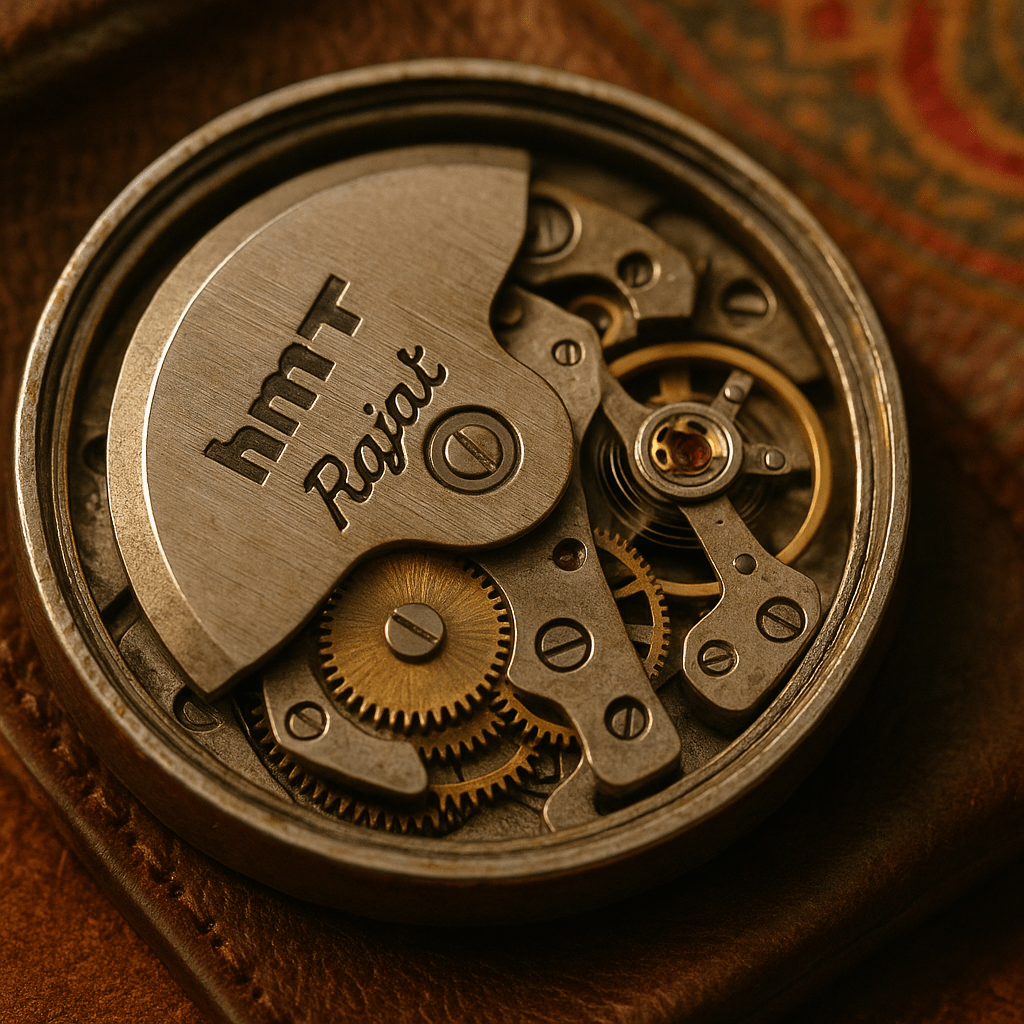
    I was eight when my grandfather slipped off his HMT Rajat, pried open the case‑back with a battered pen‑knife, and showed me the oscillating rotor. “It powers itself as long as you keep moving,” he said, half professor, half magician.

    That tiny swinging weight—no batteries, no screens—hooked me for life. The allure wasn’t price or prestige; it was engineering poetry you could wear.


    Fast‑forward to adulthood: tech life, restless hands

    By day I’m a tech consultant untangling cloud architectures and spaghetti code. The work is cerebral, digital, ephemeral. Watches became my analog counterweight—gears you can actually hear ticking after a day full of Slack pings.

    In the past few years I doubled‑down on the hobby because:

    1. Depth – Horology is an endless rabbit‑hole: movements, finishing, micro‑brands, history.
    2. Mindfulness – Winding a mechanical watch each morning is a 10‑second meditation.
    3. Community – Nothing sparks conversation like spotting a familiar dial across a conference table.

    I’ve already infected my wife, brother, and a couple of colleagues with the bug. This blog is simply the next, inevitable spiral: learn more together and pay forward what I pick up.


    “Spend less than you make, and invest the rest”

    Morgan Housel hammers this idea throughout The Psychology of Money:

    “Spending money to show people how much money you have is the fastest way to have less money.” — TPoM, Chap. 7

    That resonates. I earn a decent living but prefer value over flex—which is why you’ll see me index more on affordable watches under 2K. It’s a sweet spot where craftsmanship meets pragmatism; wealth you don’t see belies the real flex. That doesn’t mean that I don’t drool over the more expensive timepieces, which I’m sure most of my readers do as well. So, I’ll surely create content spotlighting such watches, their brands and the history behind them.


    My first “serious” watch: Sinn 104 St SA

    Last year my wife surprised me with a Sinn 104. It nails everything I love:

    • Tool‑watch toughness
    • Day‑date complication (beats checking a screen)
    • Design that toggles between boardroom and barbecue

    It also proved you don’t need a Swiss marquee to own a lifetime piece—another ethos you’ll see here.


    But … didn’t you ditch the Apple Watch?

    Yup. I wanted less beeping on my wrist.

    Problem: I still need health metrics and multiple time‑zones (family in India, clients worldwide).

    Solution:

    • Oura Ring Gen 3 for covert fitness tracking (battery lasts a week; no glowing rectangle).
    • A rotating roster of mechanical watches with use‑case complications: GMT hand when traveling, day‑date for office cadence, timing bezel for workouts.

    Call it digital minimalism with analog flair—and yes, it squares with the cost‑conscious mantra because the ring replaces annual smart‑watch churn.


    What to expect from this blog

    1. Plain‑English explainers – Movements, servicing, water resistance, lume, you name it.
    2. Curated watch reviews – Always under $2 k, with real‑world wear tests.
    3. History & stories – From HMT’s role in post‑Independence India to Sinn’s aviation roots.
    4. Buying used, safely – Marketplaces, red‑flags, and negotiation scripts.
    5. Money matters – Total‑cost‑of‑ownership calculators and “buy once, cry once” spreadsheets (coming soon).
    6. Interviews & community spotlights – Everyday collectors, not just influencers.

    How you can dive in right now

    • Subscribe to the newsletter (form in the sidebar).

    Thanks for stopping by—wind your watch, stay curious, and let’s demystify mechanical timepieces together.


    Next up: “Mechanical vs. Quartz vs. Automatic—A 5‑Minute Primer.” Stay tuned.