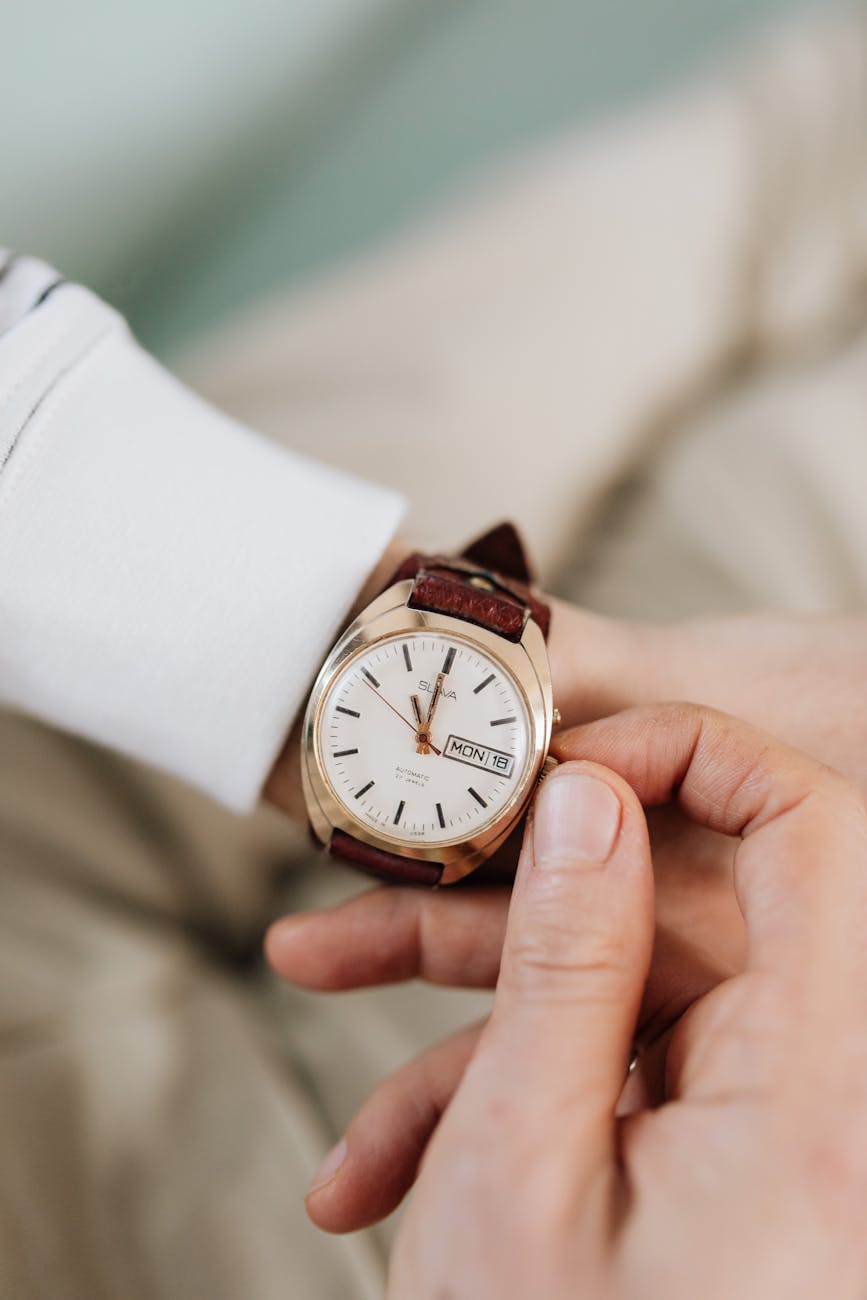
Avoiding overwinding and maintaining accuracy
Why Winding Matters
A mechanical watch stores energy in its mainspring. Keeping that spring in its ideal tension “sweet spot” (roughly the first 70-80 % of its power reserve) lets the balance wheel swing with consistent amplitude, which is what keeps time reliably. Winding correctly therefore isn’t just about avoiding damage—it’s about day-to-day accuracy.
1. Know What’s on Your Wrist
| Movement type | Typical power-reserve (hrs) | Clutch to stop overwind? | Best practice |
|---|---|---|---|
| Manual-wind (e.g., ETA 6497) | 38–50 | No – you can force breakages | Wind once a day at the same time |
| Modern hand-wind (e.g., Peseux 7001) | 42–55 | No | Wind until resistance, stop |
| Automatic (e.g., ETA 2824, Miyota 9000) | 38–70 | Yes – slipping bridle | 30–40 crown turns after a full stop, then rely on wrist wear |
2. When Should You Wind?
- Manual watches: every morning before you strap it on. A daily routine prevents the amplitude dip that creeps in as the spring relaxes.
- Automatics you don’t wear daily: give them a 30-40-turn “top-off” once a week or whenever they’ve stopped. Doing so resets the power reserve and the lubricants inside stay evenly distributed.
3. The Safe Winding Routine (Step-by-Step)
- Take the watch off your wrist – avoids lateral pressure on the stem.
- Unscrew the crown (if it’s a screw-down) to position 0.
- Turn the crown clockwise in smooth, quarter-turn flicks.
- Manual: expect 20-40 turns; resistance will grow steadily.
- Automatic: expect a soft “whir” and little resistance at first.
- Stop the instant you feel firm resistance – that is the spring at full tension. For automatics the bridle will slip silently beyond this point, but continuing serves no purpose.
- Push / screw the crown back in to maintain water-resistance.
4. “Overwinding” — Myth vs Reality
- Manual: Forcing past the stop can shear the arbor or snap the mainspring. That’s true overwinding.
- Automatic: The slipping bridle means you cannot overwind in normal use. You can still break the stem or crown if you crank excessively hard.
- Rule of thumb: Resistance = Stop. Any grinding, squeaking or sudden looseness warrants a watchmaker’s inspection.
5. Accuracy Tips
- Stay topped-up: A fuller mainspring keeps the balance amplitude steadier, improving rate stability by 3–6 s/day on many calibres.
- Avoid partial winds: Chasing a “few quick turns” multiple times a day creates uneven torque curves. One full wind is better than three half-winds.
- Consistent posture: Wind at roughly the same time and position (crown pointing down) to minimise lubricant migration.
- Service on schedule: Dried or displaced lubricants are the #1 culprit for erratic amplitude, not overwinding.
6. Quick-fire FAQ
- Can I wind backward? Not needed. Most modern movements disengage in reverse but some vintage pieces don’t—avoid unnecessary wear.
- How many turns is “full”? Your manual is king, but 25–35 is common. Stop at resistance.
- Daily winding hurts the crown threads, right? Not if you’re gentle and keep the tube gasket lubricated at each service interval.
- Should I buy a winder? Only if you have many automatics with complications (perpetual calendar, etc.). Otherwise, a manual top-off is simpler.
Take-away
Winding a mechanical watch correctly boils down to three habits:
- Off-wrist, smooth clockwise turns.
- Stop at first firm resistance.
- Keep a consistent daily routine.
Master those, and you’ll protect your mainspring, keep time accurately, and enjoy that satisfying crown-click for decades to come.
Watch & Learn — Helpful YouTube Walk-throughs
1. How to wind an automatic watch
2. Automatic Movement Best Practices. Proper Winding, Helicopter Rotor, Movement Longevity.
Stay ticking!
Share & Subscribe
If this deep dive made you look at your wrist differently, share the post and subscribe to Mechanical Minutes for more no‑nonsense horology every week.
 Mechanical Minutes