Tag: watch

  • Watchmakers Beyond Patek, Rolex & AP

    Watchmakers Beyond Patek, Rolex & AP

    A Look Past the Usual Icons

    Patek Philippe, Rolex, and Audemars Piguet dominate the modern imagination. These maisons built reputations that echo far beyond watch collecting. Yet a quieter and more intricate world exists past these giants.

    It is a world defined by invention, obsessive craft, unusual mechanical ideas, and the kind of focus that can only come from creators who refuse to scale beyond what their hands can control. This is where connoisseurs drift when they want substance rather than status alone


    F. P. Journe and the Philosophy of Originality

    François Paul Journe founded his company with a personal promise printed on every dial: made according to an ideal. His approach blends classical inspiration with mechanical ideas drawn from the fringes of traditional engineering.

    Signature Creations

    Chronometre a Resonance
    Two balances that influence one another through natural resonance, producing a form of timekeeping that is as rare as it is elegant.

    Tourbillon Souverain
    A tourbillon paired with a constant force system that stabilizes torque for improved precision.

    Elegante Collection
    A quartz movement designed with the seriousness of a mechanical caliber, capable of entering a rest state to preserve energy.

    Expected Retail Range

    Time only models begin around thirty thousand dollars.
    Complications range widely from eighty thousand dollars upward.
    Tourbillons and resonance pieces regularly exceed two hundred thousand dollars.

    A close-up view of an F.P. Journe wristwatch
    Rama, CC BY-SA 2.0 FR https://creativecommons.org/licenses/by-sa/2.0/fr/deed.en, via Wikimedia Commons

    Breguet and the Birth of Modern Horology

    Founded in seventeen seventy five, Breguet is the cradle of many concepts that now seem foundational. The tourbillon, the use of engine turned surfaces, and the open tipped hands the world still associates with the brand all began here.

    Today Breguet’s work remains quietly majestic. These are pieces for collectors who enjoy the calm of classical design and deep finishing.

    Signature Creations

    Classique Collection
    A study in proportion, featuring enamel dials, thin cases, and refined movements.

    Tradition 7047
    A dramatic fusion of tourbillon and fusee and chain technology that channels eighteenth century theory into a modern stage piece.

    Marine Collection
    Evokes a long history of maritime timekeeping with a contemporary voice.

    Expected Retail Range

    Classique models begin around eighteen thousand dollars.
    High complications extend from sixty thousand dollars to above two hundred thousand dollars.

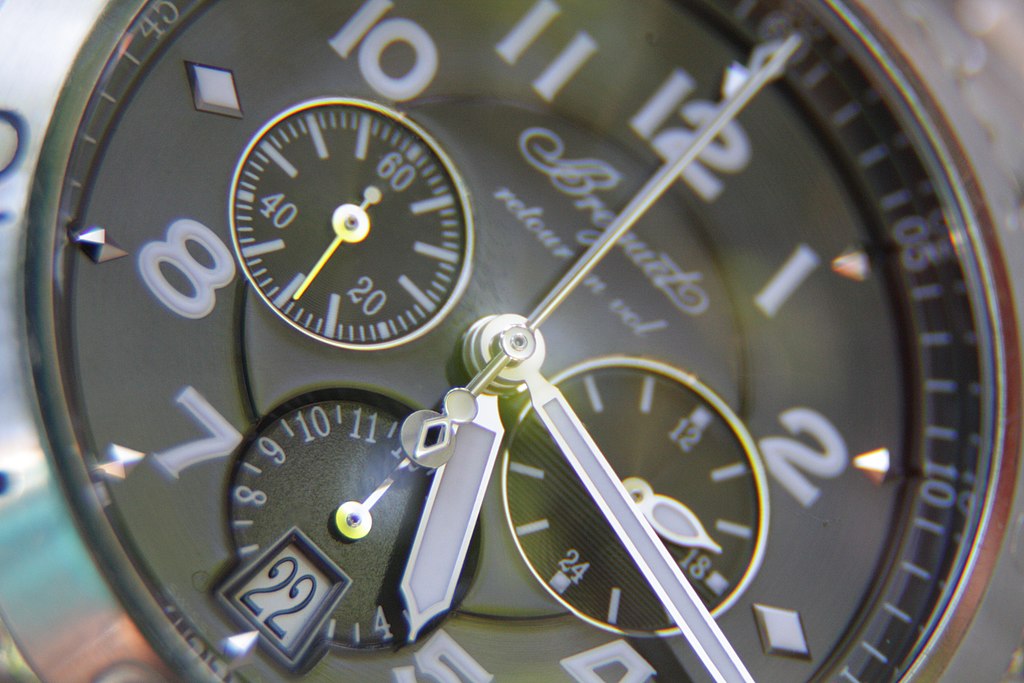
    Close-up of a Breguet watch featuring a decorative silver dial with multiple subdials, Roman numerals, and a brown leather strap.
    Rama, CC BY-SA 2.0 FR https://creativecommons.org/licenses/by-sa/2.0/fr/deed.en, via Wikimedia Commons

    A. Lange & Söhne and the Saxon Ideal

    After decades of silence during the twentieth century, A. Lange & Söhne returned in nineteen ninety four with a clear mission: to reclaim German precision and present it in an uncompromising modern form.

    Its movements are architectural. Its finishing is disciplined. And its design language is both severe and poetic.

    Signature Creations

    Lange One
    Often called the most successful asymmetrical design in modern watchmaking, built on a strict mathematical grid.

    Datograph Up Down
    A chronograph of such balance and refinement that it is often considered the benchmark of the entire category.

    Zeitwerk
    A mechanical jumping time display powered by a complex constant force mechanism.

    Expected Retail Range

    Many three hand models begin near thirty thousand dollars.
    Datograph and Zeitwerk pieces often range between eighty thousand and one hundred fifty thousand dollars.

    A. Lange & Söhne Lange 1 Daymatic
    A. Lange & Söhne Lange 1 Daymatic © A. Lange & Söhne

    Vacheron Constantin and the Power of Continuity

    Vacheron Constantin has been crafting watches since seventeen fifty five, making it one of the oldest continuously operating maisons in existence. Its work is refined, serene, and deeply tied to the traditions of Geneva.

    Signature Creations

    Patrimony Collection
    Pure minimalism with gentle curves and movements finished to Geneva Seal standards.

    Overseas Collection
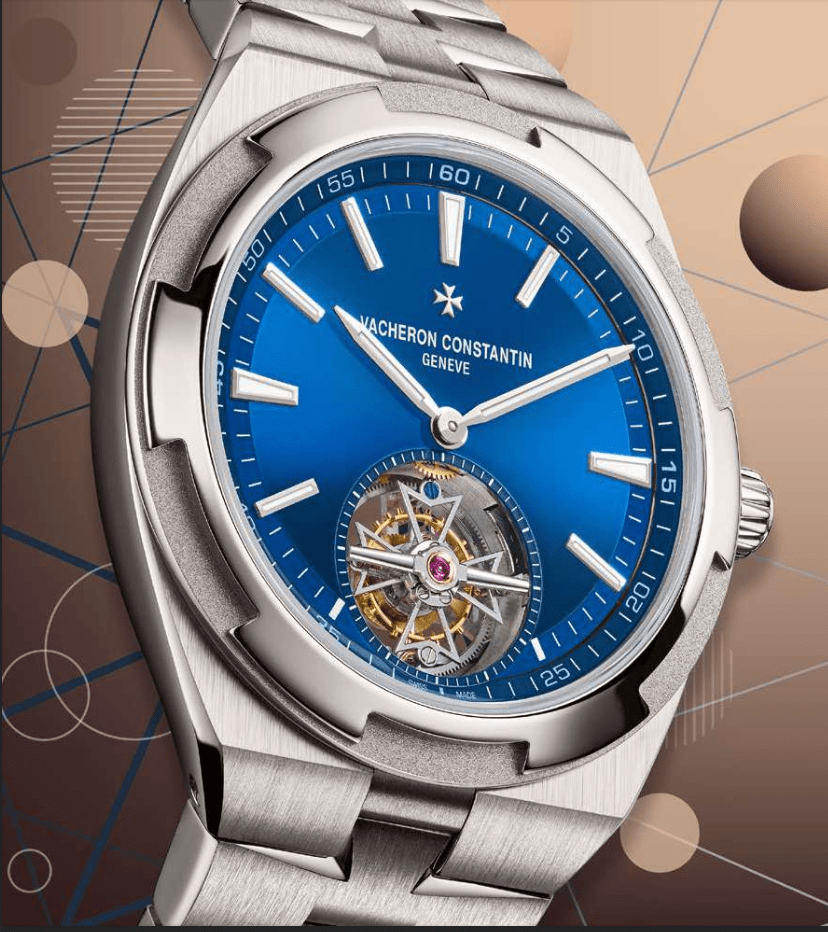
    A versatile sports watch with a bracelet known for its comfort and strong technical foundation.

    Historique American 1921
    A driver’s watch with a rotated dial that channels early twentieth century charm.

    Expected Retail Range

    Dress models begin near twenty thousand dollars.
    Complications extend from fifty thousand dollars to two hundred thousand dollars and beyond.

    Vacheron Constantin Overseas Turbillon
    Vacheron Constantin Overseas Turbillon © Vacheron Constantin

    Parmigiani Fleurier and the Cult of Proportion

    Michel Parmigiani began as a restorer of historical pieces, and that background echoes through his designs. Every curve and bevel feels considered. Nothing is loud, yet everything is intentional.

    Signature Creations

    Tonda PF Micro Rotor
    Understated elegance in an ultra thin form, with a warm presence on the wrist.

    Toric Chronograph
    Inspired by classical architectural geometry.

    Kalpa Collection
    A distinctive curved case with in house calibers.

    Expected Retail Range

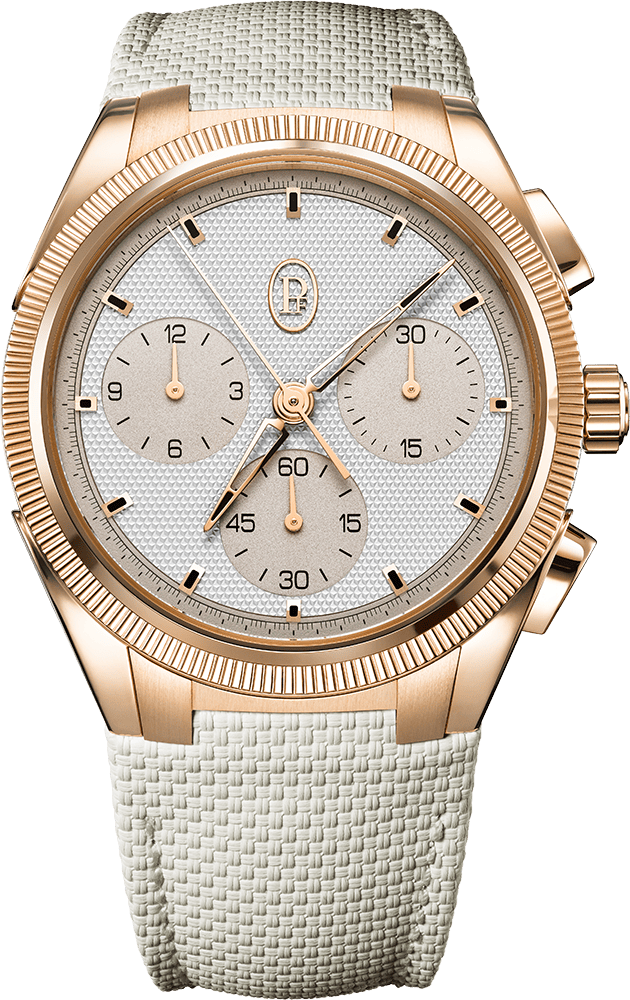
    Most Tonda PF models fall between twenty thousand and thirty five thousand dollars. Complications stretch upward from fifty thousand dollars.

    Parmigiani Fleurier Tonda PF Chronograph
    Parmigiani Fleurier Tonda PF Chronograph © Parmigiani Fleurier

    The Independent Atelier Landscape

    Beyond the heritage maisons is a constellation of independent creators who treat watchmaking as a calling rather than an industry. Their production numbers are often in the dozens rather than thousands.

    Notable Names

    Laurent Ferrier
    Soft lines, natural escapement technology, and serene finishing.

    Voutilainen
    Hand worked dials, vivid color, and extraordinary movement decoration.

    H. Moser and Cie
    Minimalist design blended with surprising technical depth and a willingness to question convention.

    Typical Retail Range

    Most independents begin around thirty thousand dollars and ascend rapidly depending on complications and rarity.

    H. Moser & Cie Streamliner Perpetual Moon Concept Meteorite
    H. Moser & Cie Streamliner Perpetual Moon Concept Meteorite, source: MOSER SCHAFFHAUSEN AG

    Why Explore Beyond the Familiar

    The maisons beyond Patek, Rolex, and AP remind us that watchmaking is not only about prestige. It is about curiosity, courage, and devotion to craft.

    Collectors who follow these paths discover timepieces that reflect more than success. They reflect taste, patience, and a genuine connection to the art.


  • Staying Up-to-Date on Watches in 2025

    Staying Up-to-Date on Watches in 2025

    In horology, things move fast. New releases drop every week, auction results shake up the market, and brands keep reinventing how they connect with enthusiasts. If you want to stay current, you need a set of trusted sources. Here are the platforms I use to keep myself plugged into the watch world.


    Websites Worth Bookmarking

    • Hodinkee – Probably the most recognizable watch media outlet. Best for deep-dive reviews, industry news, and high-quality photography. Great if you want context and storytelling.
    • Fratello Watches – Known for strong editorial opinions and their “Speedy Tuesday” coverage of Omega. Good for thoughtful commentary and in-depth comparisons.
    • Monochrome Watches – Technical breakdowns and detailed reviews, often covering independent and high-horology brands.
    • WatchTime – Traditional magazine style with serious reviews and coverage of the watch fair circuit.
    • Time+Tide – Australia-based, global in reach. Good mix of video, written reviews, and quick news hits.

    YouTube Channels to Follow

    • Watchfinder & Co. – Benchmark channel for visual reviews. Their macro photography is unmatched, making movements and finishing details easy to appreciate.
    • Teddy Baldassarre – Balanced mix of reviews, buying guides, and education on movements and brands.
    • The Urban Gentry – Personal, story-driven approach. Strong on watch history and collecting philosophy.
    • Theo & Harris – Lively, opinionated commentary. Good for learning the cultural side of watches.
    • Just One More Watch – Accessible microbrand reviews and budget-friendly recommendations.

    Social Media Accounts


    Final Thoughts

    Staying updated on watches doesn’t mean chasing every hype drop. It’s about curating sources that give you perspective, whether you’re into Rolex auctions, microbrand discoveries, or movement tech. Pick a few outlets that resonate with your style and you’ll always be in sync with the horological conversation.


  • Top 10 Watch Movements for Collectors

    Top 10 Watch Movements for Collectors

    What makes a watch truly worth collecting? The dial might charm, and the case might shine—but it’s the movement underneath that tells the real story. For collectors, the caliber powering the watch isn’t just a mechanism; it’s the soul of the timepiece.

    In today’s post, I will spotlight 10 watch movements that every modern collector should know—grouped not by price or brand, but by their real-world relevance, horological significance, and mechanical merit. From reliable entry-level staples to movements that define luxury watchmaking, these are the engines shaping the wristwatch world in 2025.


    The Everyday Legends

    Affordable, accessible, and the backbone of the enthusiast community


    1. Miyota 9015 – The Microbrand Powerhouse

    Techné Harrier Ref. 363 (Miyota 9015), versions 132 & 031,
    Techné Harrier Ref. 363 (Miyota 9015), versions 132 & 031, via Wikimedia Commons, licensed under CC BY-SA 4.0.

    Used in: Zelos, Baltic, Lorier, Laco
    Specs: Automatic, 28,800 vph, 42-hour power reserve, hacking & hand-winding

    The Miyota 9015 is the unsung hero of the modern microbrand scene. Thin, reliable, and cost-effective, it’s a Swiss ETA alternative made in Japan—perfect for slim, everyday automatics. Its high beat rate gives a satisfying sweep, and it’s used in watches often priced under $1,000.


    2. Seiko NH35 (a.k.a. 4R35) – The People’s Choice

    Buy the Seiko NH35 movement on eBay
    Buy the Seiko NH35 movement on eBay

    Used in: Seiko 5, Invicta, Vostok Europe, many modded builds
    Specs: Automatic, 21,600 vph, 41-hour power reserve, hacking

    One of the most mass-produced movements in the world, the NH35 is beloved by modders and budget brands alike. It’s durable, serviceable, and works forever—literally, some watches run for a decade with no intervention. What it lacks in finesse, it makes up for in rugged character.


    3. ETA 2824-2 – The Swiss Benchmark

    ETA 2824-2 Automatic Movement
    ETA 2824-2 Automatic Movement, via Wikimedia Commons, licensed under CC BY-SA 3.0 DE.

    Used in: Hamilton, Tissot, Steinhart, Sinn
    Specs: Automatic, 28,800 vph, 38-hour power reserve

    Even with limited availability, the ETA 2824-2 is still one of the most respected entry-level Swiss movements. Known for its smooth sweep, compact build, and high accuracy, it’s a trusted choice in field watches, divers, and affordable luxury pieces alike.


    4. Sellita SW200-1 – The Reliable Stand-In

    Christopher Ward C8 Power Reserve Chronometer featuring the Sellita SW200-1 movement
    Christopher Ward C8 Power Reserve Chronometer featuring the Sellita SW200-1 movement, via Wikimedia Commons, licensed under CC BY 2.0.

    Used in: Sinn, Oris, Christopher Ward, Formex
    Specs: Automatic, 28,800 vph, 38-hour power reserve

    When ETA restricted movement supply, Sellita became the savior for many independent brands. The SW200-1 is an ETA 2824 clone that’s been steadily improved. Today, it’s practically indistinguishable in terms of performance, and widely adopted in rugged tool watches under $2K.


    Chronograph Powerhouses

    Still the heart of the modern chronograph scene


    5. Valjoux 7750 – The Chrono Classic

    Valjoux 7750 Movement in Franchi Menotti Automatic Chronograph
    Valjoux 7750 Movement in Franchi Menotti Automatic Chronograph, via Wikimedia Commons, licensed under CC BY-SA 4.0.

    Used in: Sinn 103, Hamilton Khaki Chronograph, Fortis
    Specs: Automatic Chronograph, 28,800 vph, 42-hour power reserve

    The Valjoux 7750 is the most popular automatic chronograph movement in the world. With its distinctive rotor wobble and loud ticking, it’s not subtle—but it is reliable. Collectors appreciate it for its rich history and continued use in rugged, aviation-style chronographs.


    Innovators & Icons

    Where engineering meets elegance


    6. Omega Co-Axial Caliber 8900 – The Escapement Revolution

    Omega Seamaster Planet Ocean Ref. 215.30.44.21.03.001 featuring the Co-Axial Master Chronometer Caliber 8900
    Omega Seamaster Planet Ocean Ref. 215.30.44.21.03.001 featuring the Co-Axial Master Chronometer Caliber 8900, via Wikimedia Commons, licensed under CC BY-SA 4.0.

    Used in: Seamaster Diver 300M, Aqua Terra, Globemaster
    Specs: Automatic, 25,200 vph, 60-hour power reserve, METAS-certified

    This is the movement that set Omega apart in modern watchmaking. With George Daniels’ co-axial escapement and anti-magnetic silicon parts, the Caliber 8900 offers incredible long-term stability. Certified by METAS, it exceeds COSC standards and delivers next-level performance for under $10K.


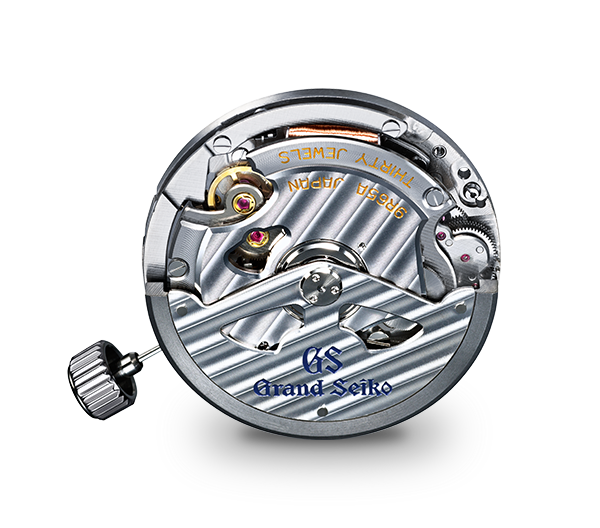
    7. Grand Seiko Spring Drive 9R65 – Glide into Precision

    Grand Seiko Movement
    Source: Grand Seiko USA

    Used in: SBGA211 “Snowflake,” SBGA413 “Cherry Blossom”
    Specs: Hybrid (mechanical + quartz), ±1s/day, 72-hour power reserve

    The 9R65 is where mechanical craftsmanship meets quartz accuracy. Exclusive to Grand Seiko, it produces the smoothest seconds hand sweep in the business—no ticking, just pure glide. For collectors who love tradition but crave precision, this movement is a technical marvel.


    8. Jaeger-LeCoultre Caliber 899 – The Elegant Performer

    A close-up of a Jaeger-LeCoultre wristwatch featuring a silver dial, gold hour and minute hands, a date window, and two sub-dials, worn on a wrist with a black leather strap.
    Jaeger-LeCoultre Master Control Hometime Ref. 147.2.05.S, via Wikimedia Commons, licensed under CC BY-SA 4.0.

    Used in: JLC Master Control, Polaris
    Specs: Automatic, 28,800 vph, 70-hour power reserve

    JLC is often behind the scenes, making movements for other big names. But the Caliber 899 proves they deserve the spotlight. Thin, beautifully decorated, and highly reliable, it’s a collector’s favorite in refined dress watches that don’t sacrifice engineering for elegance.


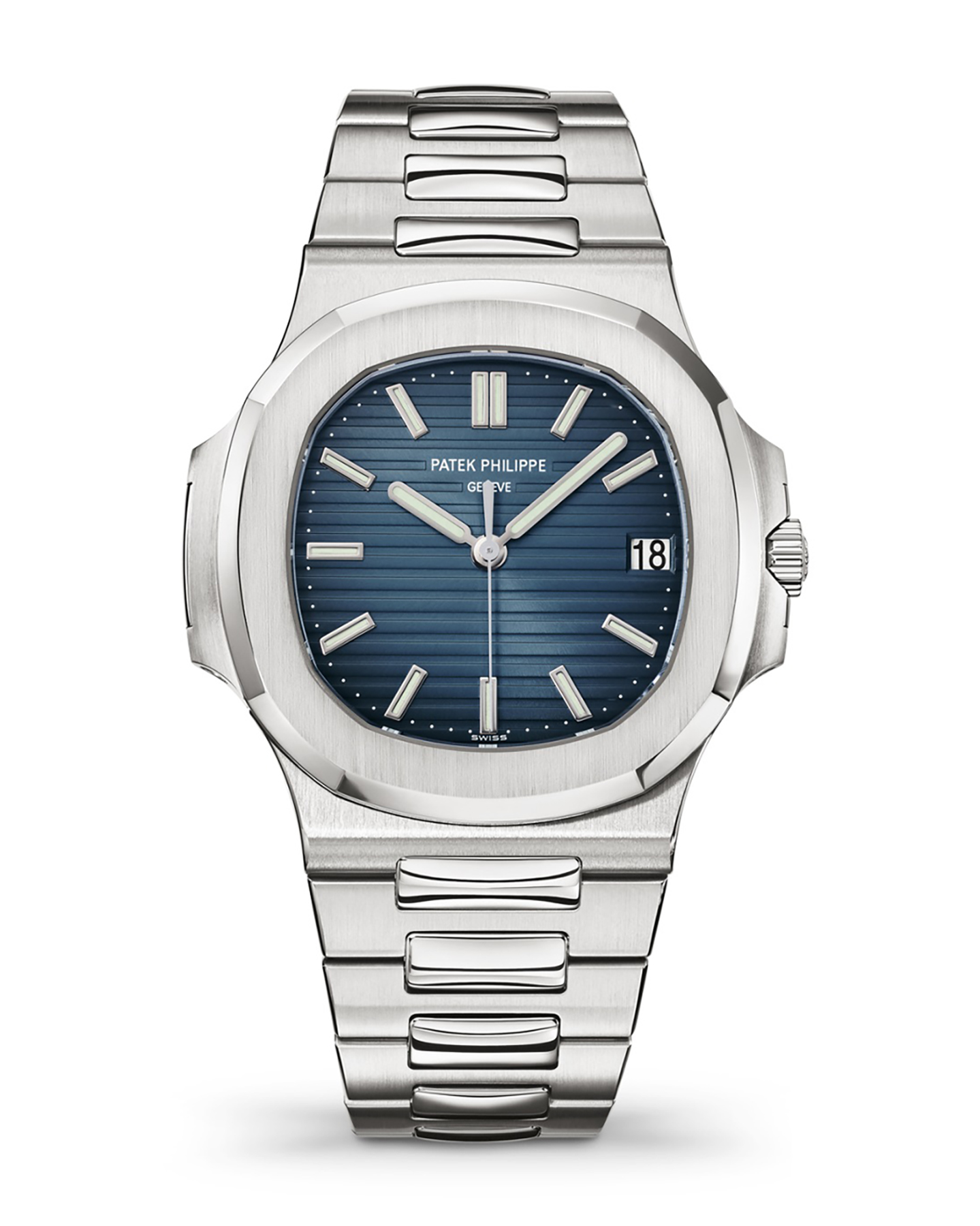
    9. Patek Philippe Caliber 324 S C – Haute Horlogerie, Refined

    A stainless steel Patek Philippe watch featuring a blue dial with horizontal stripes, silver hour markers, and a date display. The watch has a sleek, integrated bracelet and an octagonal bezel, showcasing its modern design.
    Iconic Patek Philippe Nautilus Ref. 5711/1A-010 featuring Caliber 324 S C, via Wikimedia Commons, licensed under CC BY-SA 4.0.

    Used in: Calatrava, Nautilus (earlier references)
    Specs: Automatic, 28,800 vph, 45-hour power reserve

    One of Patek Philippe’s signature movements, the 324 S C is known for exquisite finishing, tight tolerances, and smooth winding. It’s found in some of the most collectible watches ever made, and while not as complicated as a tourbillon, its refinement is second to none.


    10. Rolex Caliber 3235 – The Modern Rolex Workhorse

    Close-up of a Rolex Sea-Dweller watch featuring a black dial, luminous markers, and a stainless steel bracelet.
    Rolex Sea-Dweller, featuring Caliber 3235, by John Torcasio, CC BY-SA 3.0, via Wikimedia Commons

    Used in: Rolex Datejust 41, Submariner Date, Sea-Dweller, Yacht-Master
    Specs: Automatic, 28,800 vph, 70-hour power reserve

    Rolex’s flagship automatic movement, the Caliber 3235, powers most of their modern lineup and represents a significant evolution from the long-serving 3135. It features the proprietary Chronergy escapement—optimized for efficiency—and a longer mainspring, resulting in a robust 70-hour reserve. With a Parachrom hairspring, Paraflex shock protection, and Superlative Chronometer accuracy, it blends daily reliability with technical refinement. While not haute horology, it’s one of the most battle-tested and serviceable modern calibers in high-end watchmaking, built for longevity and precision.


    Final Thoughts: Know What Drives Your Watch

    Behind every great watch is a great movement. Whether you’re exploring microbrands, investing in your first Swiss automatic, or dreaming of your next haute horlogerie piece, understanding the engine inside your timepiece gives your collection meaning and depth.

    These 10 movements aren’t just parts—they’re proof that watchmaking is alive, evolving, and accessible at every level of collecting.


    Stay curious. Stay passionate. And as always—stay ticking.

  • HMT Watches: A Legacy of Indian Timekeeping

    HMT Watches: A Legacy of Indian Timekeeping

    The Watch That Ticked Into My Life

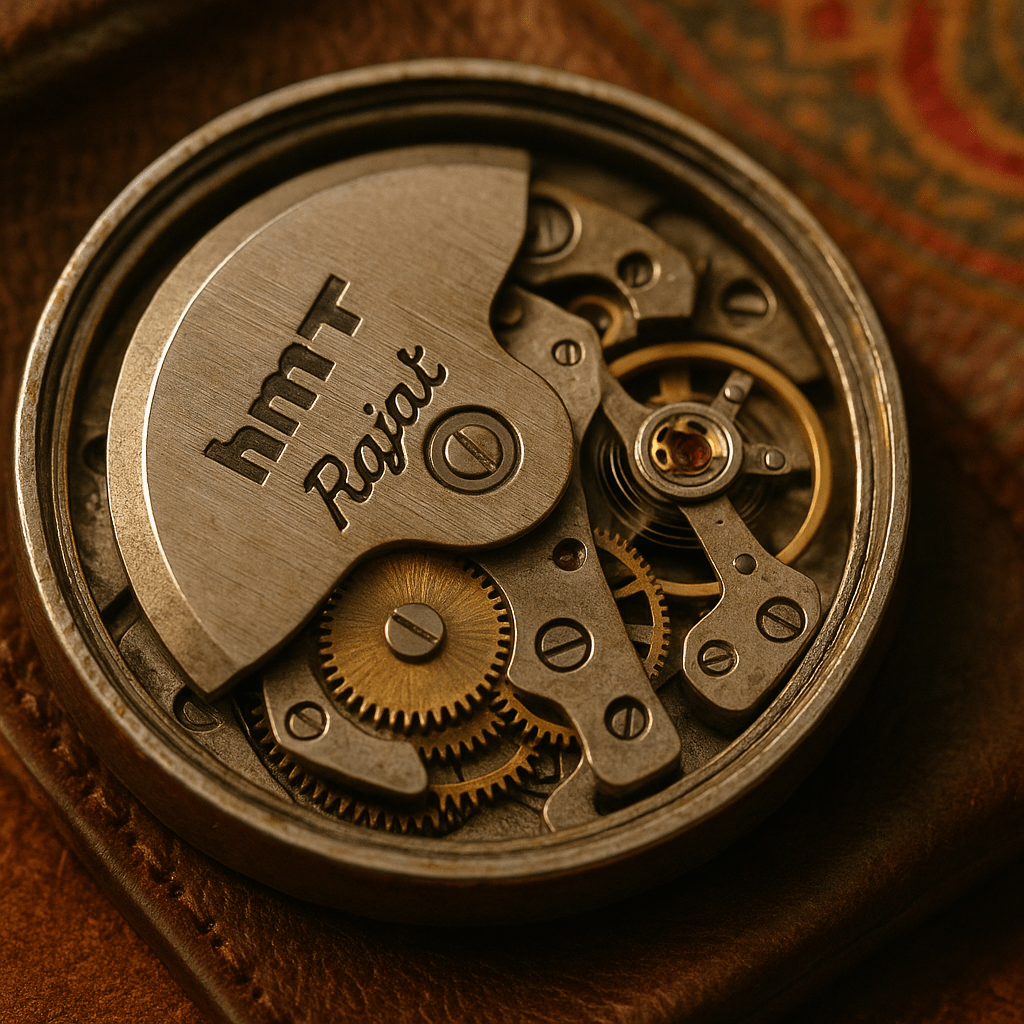
    My grandfather’s worn-out HMT Rajat is still the most precious watch in my collection.

    The first mechanical watch I ever held wasn’t mine—it was my grandfather’s. A slim, silver-dialed HMT Rajat, always peeking out from under the cuff of his kurta. He would wind it each morning with a quiet reverence, as though awakening something sacred. It wasn’t just a tool to tell time—it was a symbol.
    Through him, I discovered that HMT wasn’t just a watch brand. It was a badge of honor, a retirement gift, a wedding present, a milestone. Owning an HMT meant something in India—because it was India’s timekeeper.

    As someone who now explores microbrands and affordable mechanical watches through my blog Mechanical Minutes, I wanted to step back and honor the brand that put India on time—and did it with dignity, precision, and pride.

    The Backdrop: India’s Tryst with Industrial Destiny

    When India gained independence in 1947, the country’s leadership knew that self-reliance wouldn’t just come from freedom—it needed factories, tools, and technology.

    In 1953, Hindustan Machine Tools (HMT) was born as a state-owned enterprise focused on machine tools. But it wasn’t long before Nehru’s vision expanded. By 1961, with technical assistance from Japan’s Citizen Watch Co., HMT took on a new mission: manufacturing India’s very first wristwatches.

    This wasn’t just industrial diversification—it was nation-building on your wrist.

    HMT’s Contributions: Timekeeping as Nation-Building

    🏭 Made in India, For Indians

    HMT created watches in India, by Indians, for Indians—a revolutionary concept in an era where imported Swiss watches were luxuries few could afford. These weren’t mass-manufactured gadgets—they were engineered with care, often by skilled artisans trained in Japan and Switzerland.

    “Time is money, they say. But in India, time was also identity. And HMT gave it form.”

    ⏱️ Mechanical Movements for the Masses

    Where the world was shifting to quartz, HMT doubled down on manual-wind mechanical calibers—tough, repairable, and romantic in their ticking rhythm. The Caliber 020, based on Citizen’s movement, powered many iconic models like the Janata, Sona, and Rajat.

    Some innovations include:

    • Shock-resistant designs, rare in that price bracket.
    • Hand-finished dials, often with subtle textures or sunburst effects.
    • Slim cases and domed acrylics, styled with Bauhaus-like restraint.

    🎓 Skill Transfer & Watchmaking Ecosystem

    HMT didn’t just make watches—it built an entire generation of Indian watchmakers, many of whom would later go on to launch private ventures. Its training programs were rigorous and respected, often mirroring Swiss watchmaking pedagogy.

    Why Were HMT Watches So Prestigious?

    Before Titan, before Seiko’s Indian presence, HMT was the gold standard of wristwatches in India. If you received one:

    • At retirement—it meant your service was honored.
    • As a gift—it meant you were respected.
    • At marriage—it symbolized a lifelong promise.

    They had emotional value, but also social status. A man wearing an HMT was punctual, disciplined, and “set in time.”

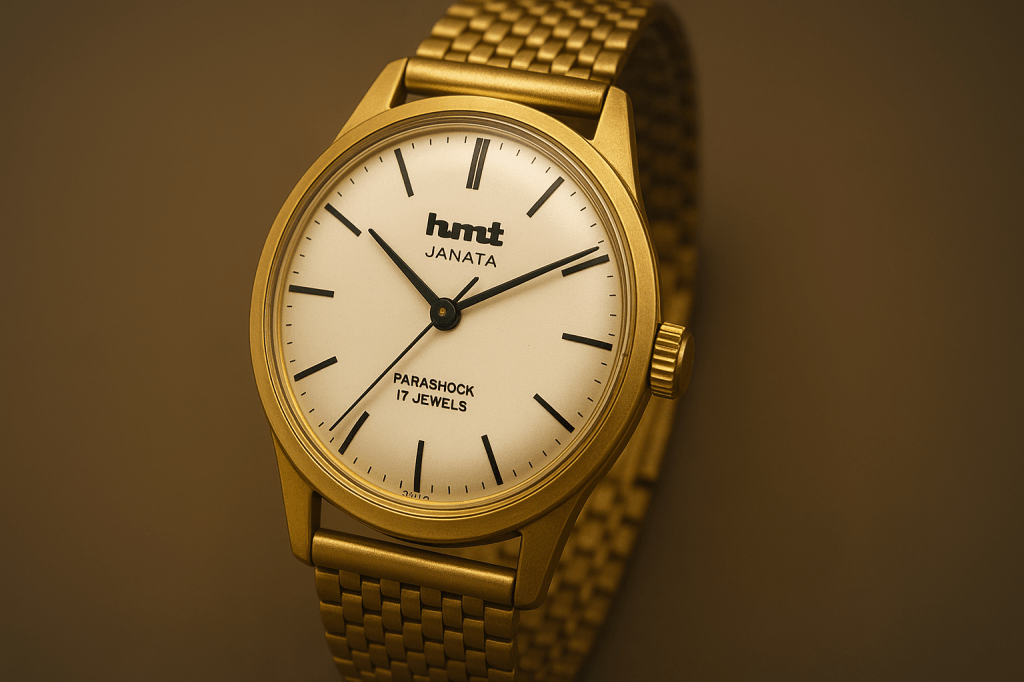
    HMT Janata, via Wikimedia Commons, licensed under GNU

    The Golden Age: Models That Defined Generations

    Let’s talk icons:

    • HMT Janata: Worn by Nehru himself. Clean Arabic numerals. Reliable hand-wind.
    • HMT Pilot: A robust, field-style watch with cult status.
    • HMT Sona & Rajat: Elegant dress watches in gold and silver tones, often passed down generations.
    • HMT Jawan: Issued to the Indian Army—practical, matte, and hard-as-nails.

    HMT Watches on display, via Wikimedia Commons, licensed under CC BY-SA 4.0

    What Made HMT Special Technically?

    HMT Jhalak via Wikimedia Commons, licensed under GNU

    Beyond nostalgia, these watches had horological merit:

    In-house assembly: Movements were hand-assembled in India, not imported as kits. Low-beat but long-lasting: 18,000–21,600 bph calibers optimized for longevity, not flash. Serviceable for decades: You could find a watch repair guy in any town who knew HMT guts.

    This “tool-for-life” philosophy made them more than machines—they were companions.

    The Slow Ticking Out: What Went Wrong?

    Photo by Raunak Jha on Unsplash

    The Quartz Crisis hit HMT harder than most. By the late 1980s, consumers wanted slimmer, battery-powered watches. HMT’s mechanical tooling couldn’t adapt fast enough. Their quartz lineup arrived too late—and lacked the charm of their originals.

    The 2000s saw further decline, with branding missteps, little innovation, and growing financial losses. In 2016, the Indian government officially shut down HMT Watches.

    A Cult Rebirth: HMT in the 21st Century

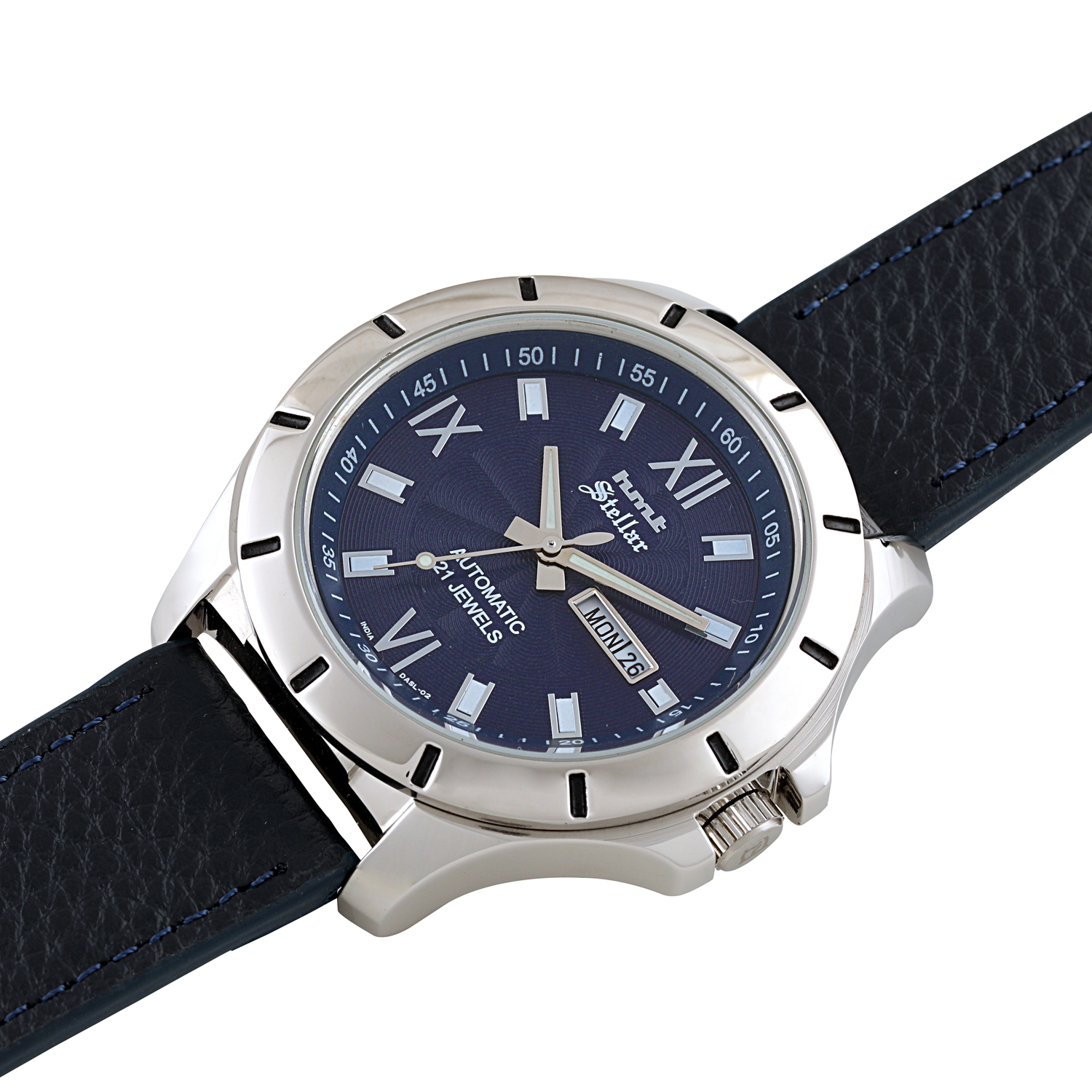
    HMT Stellar DASL 02 BLUE

    Paradoxically, HMT’s death sparked a revival. Vintage watch enthusiasts began hunting down Pilots and Janatas on eBay, refurbishing them, and showcasing them online. A new generation began to appreciate their mechanical soul.

    Even today, owning an HMT is a love letter to Indian engineering, and a reminder that not all timekeeping is digital.

    Final Words: A Personal Thanks

    I still have my grandfather’s HMT Rajat. It doesn’t work perfectly—but that’s part of the magic. It’s not just a watch. It’s a time capsule, a tribute to a time when India built its dreams from scratch, one tick at a time.

    If you’re an Indian collector, your journey begins not with a Rolex or a Nomos—but with a Janata, a Pilot, or maybe a Rajat. Check out the collection here.

    Let’s keep the legacy ticking.

  • Understanding Watch Complications: A Quick Guide

    Understanding Watch Complications: A Quick Guide

    As soon as you start surfing Chrono24, Bob’s Watches, or binge-watching Teddy Baldassarre, one thing jumps out: watches do much more than tell time. From timing a lap to summoning the phases of the moon, each “function”—or complication—adds engineering flair, price, and bragging rights.

    Below is a lightning-round tour of ten of the most talked-about functions. For each one you’ll see how it workstypical price entry points, an iconic reference, and an affordable gateway piece (when one exists—some complications stay stubbornly expensive).

    FunctionWhat Makes It TickStarting Price1Iconic PieceAffordable Gateway
    Date / Day-DateA simple disk under the dial jumps once per day.≈ $150Rolex Day-Date (aka “President”)Seiko 5 Sports
    ChronographStart/stop/reset cams2 & levers run a secondary gear-train to time events.≈ $250Omega Speedmaster “Moonwatch”Tissot PRX Chronograph
    GMT / Dual TimeA 24-hour hand geared to rotate once per day tracks a second zone.≈ $300Rolex GMT-Master II “Pepsi”Seiko 5 GMT (SSK series)
    AlarmA separate spring barrel drives a hammer that strikes an internal gong.≈ $600Jaeger-LeCoultre MemovoxSeiko “Bell-Matic” (vintage)
    Moon PhaseA 59-tooth disk advances once every 24 h to sync with the 29.5-day lunar cycle.≈ $300Patek Philippe 3940Orient Sun & Moon v4
    Tachymeter (with Chronograph)Fixed bezel or dial scale converts elapsed seconds into speed or rate.Chronograph pricingOmega SpeedmasterBulova Lunar Pilot
    Annual CalendarUses a cam programmed for 30-/31-day months; needs adjustment only on Feb 28/29.≈ $3 000Patek Philippe 5035 (first ever)Longines Master Collection Moonphase Retrograde Annual Calendar
    Perpetual CalendarLever “memory” accounts for leap years—no correction until 2100.≈ $6 000 (used)Audemars Piguet Royal Oak PerpetualNone—high-horology only
    Flyback ChronographClutch lets you reset & restart timing with one press—perfect for pilots.≈ $1400Breguet Type XXBaltic Bicompax “Panda”
    TourbillonThe entire escapement spins in a cage each minute to average out positional errors.≈ $500 (Chinese brands)Breguet Classique 5317Seagull ST8000 tourbillon

    Bite-Size Deep-Dives


    1. Date / Day-Date

    Photo by Arjunn. la on Pexels.com
    • Why it matters: Everyday convenience.
    • Geek fact: Rolex’s 1945 Datejust was the first self-winding wristwatch with an instantaneous date jump; the “quick-set” feature didn’t appear until 1977.

    2. Chronograph

    Photo by Quang Viet Nguyen on Pexels.com
    • Why it matters: Lap timing + tactile pusher feel.
    • Geek fact: Vertical-clutch chronographs (e.g., Seiko 6139, Zenith El Primero) let the seconds hand run continuously with virtually no amplitude loss—perfect for OCD accuracy nerds.

    3. GMT / Dual Time

    Photo by Bhop Phikanesuan on Pexels.com
    • Why it matters: Track two zones at once.
    • Geek fact: The Rolex 6542 “Pepsi” (1954) was developed for Pan Am pilots; its original Bakelite bezel was so fragile many were swapped for aluminum—surviving Bakelite models fetch six-figure sums.

    4. Alarm

    Seiko Bell-Matic 17 Jewels, via Wikimedia Commons, licensed under CC BY-SA 3.0 AT.
    • Why it matters: A mechanical ringtone on your wrist.
    • Geek fact: The Vulcain “Cricket” was nicknamed The President’s Watch—Truman, Eisenhower, Nixon and Johnson all wore one in the Oval Office.

    5. Moon Phase

    Photo by SevenStorm JUHASZIMRUS on Pexels.com
    • Why it matters: Pure romance.
    • Geek fact: A 135-tooth moon-phase disk (e.g., H. Moser Endeavour) drifts by one day every 122 years—over 4 × more accurate than the traditional 59-tooth setup.

    6. Tachymeter (w/ Chronograph)

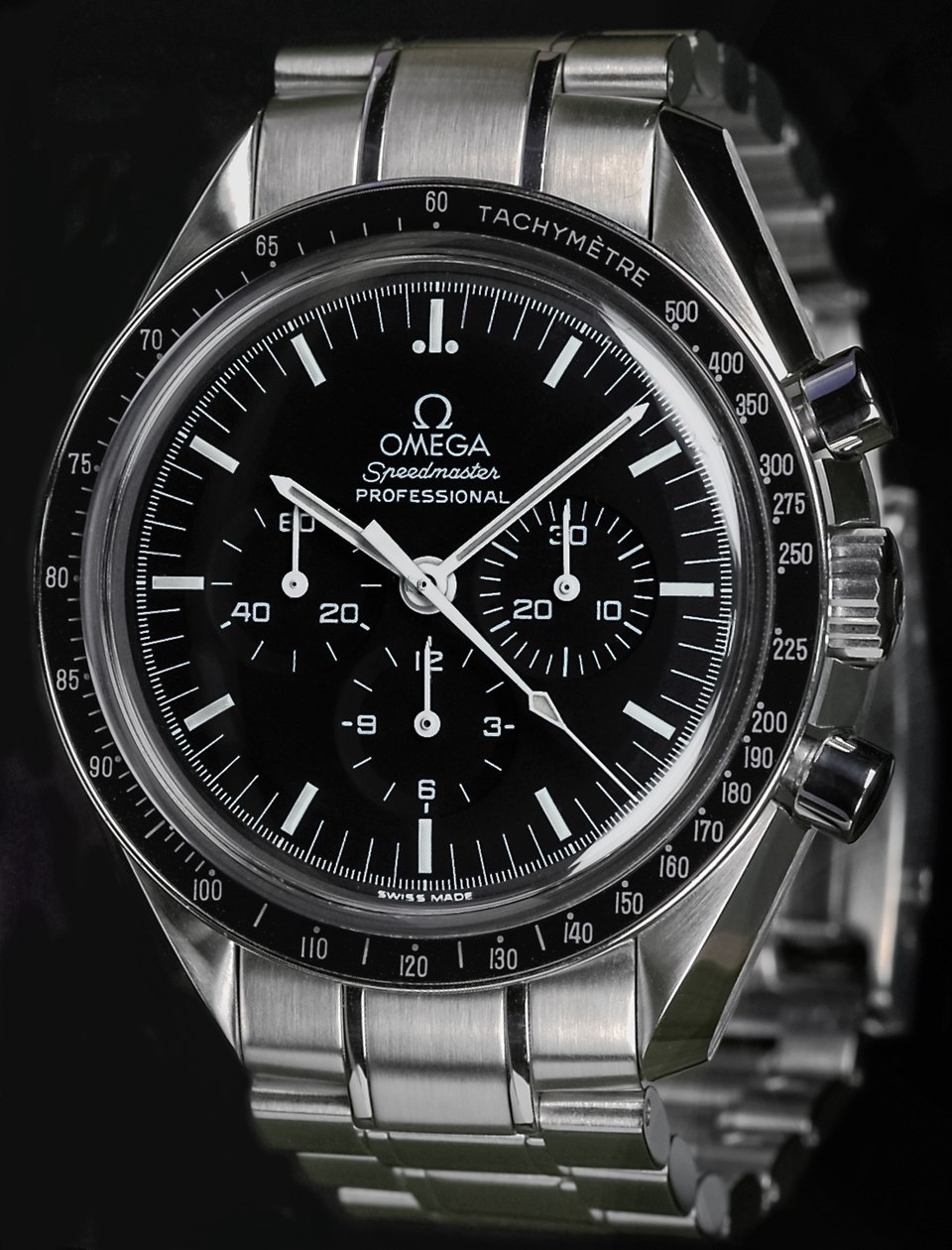
    Omega Speedmaster Professional, via Wikimedia Commons, released into the public domain by the author, Torsten Bolten.
    • Why it matters: Converts elapsed time into speed or rate.
    • Geek fact: You can flip the script—time one unit of production (say, wrapping a burrito) and the tachy scale shows burritos per hour. Fast-food nerd badge unlocked.

    7. Annual Calendar

    Jaeger-LeCoultre Master Calendar in Stainless Steel (Ref. Q151842A), via Wikimedia Commons, licensed under CC BY-SA 4.0.
    • Why it matters: Adjust once a year, not every month.
    • Geek fact: Patek Philippe created the complication only in 1996 (Ref 5035); they patented the three-cam mechanism that became the modern template.

    8. Perpetual Calendar

    Audemars Piguet Royal Oak Perpetual Calendar in Gold, mid-1990s, via Wikimedia Commons, licensed under CC BY-SA 4.0.
    • Why it matters: No correction until 2100.
    • Geek fact: Patek’s 1925 Ref 97975 was the first wrist-perpetual; its 48-month “leap-year cam” makes just one full rotation every 4 years.

    9. Flyback Chronograph

    Breguet Watch, via Wikimedia Commons, licensed under CC BY-SA 3.0.
    • Why it matters: Reset & restart with one push—ideal for navigation legs.
    • Geek fact: The Breguet Type 20 spec demanded the movement reset within 0.2 seconds—a quality-control test still enforced on modern Type XX models.

    10. Tourbillon

    Greubel Forsey Tourbillon 24 Secondes Incliné, via Wikimedia Commons, licensed under CC BY-SA 3.0.

    Geek fact: The original 1801 Breguet patent was for pocket watches; multi-axis tourbillons (e.g., Jaeger-LeCoultre Gyrotourbillon) compound the effect by spinning on two or three perpendicular axes.

    Why it matters: Rotating escapement eye-candy.


    Wrapping Up

    Complications add personality and engineering theater. Whether you’re timing a marathon or admiring a miniature lunar cycle, knowing why a function exists helps you decide if the extra cost (and service complexity) is worth it.


    Stay ticking!


    1. Typical street prices for stainless-steel pieces, new unless noted. Prices vary significantly based on brand, movement type, materials, and market demand. ↩︎
    2. Cams in watchmaking are specially shaped mechanical components that convert rotary motion into linear or intermittent movement. They are a critical part of many watch complications, particularly chronographs, where they help coordinate the start, stop, and reset actions. ↩︎

    Share & Subscribe

    If this deep dive made you look at your wrist differently, share the post and subscribe to Mechanical Minutes for more no‑nonsense horology every week.

  • 10 Watch Maintenance Mistakes to Avoid

    10 Watch Maintenance Mistakes to Avoid

    A quick, 5-minute read to keep your timepiece ticking for decades.


    1. Skipping the Post-Swim Rinse

    ❌ Mistake: Assuming “water-resistant” means “chlorine-proof.”

    ⚙️ Fix: After every swim—pool or ocean—rinse under cool tap water, pat dry, then air-dry crown-down. Salt and chemicals eat gaskets fast.


    2. Setting the Date Between 9 p.m. – 3 a.m.

    ❌ Mistake: Adjusting the date while the date-change gears are engaged.

    ⚙️ Fix: Pull the crown to time-setting, move hands past 3 a.m., then set the date. Zero stripped gears, zero drama.


    3. Over-Winding Manuals & Under-Winding Autos

    ❌ Mistake: Cranking a manual until it squeaks—or never giving an automatic its 30–40 crown turns after downtime.

    ⚙️ Fix: Stop winding manuals the moment you feel resistance. For autos at rest, give 30 smooth crown turns before wearing.


    4. Ignoring Yearly Pressure Tests on “Water-Resistant” Quartz

    ❌ Mistake: Believing quartz gaskets last forever.

    ⚙️ Fix: Pressure-test every 12–18 months if you shower or swim with it. A $30 test beats a $300 movement swap.


    5. Leaving Crowns or Pushers Un-Screwed

    ❌ Mistake: Forgetting to screw-down the crown, or pressing chrono buttons underwater.

    ⚙️ Fix: Ritualize it—wind, set, screw-down. Keep hands off pushers unless the watch is clearly rated for it (200 m+).


    6. Storing on a Hot Dashboard or in Direct Sun

    ❌ Mistake: Heat bakes lubricants and fades dials.

    ⚙️ Fix: Use a shaded drawer or travel roll. In a car, glovebox > dashboard.


    7. Magnetizing Your Movement

    ❌ Mistake: Parking the watch near laptop speakers, phone mags, or magnetic bag clasps.

    ⚙️ Fix: Keep watches 15 cm / 6 in away. Second hand stuttering? A $20 demagnetizer fixes it in 10 sec.


    8. DIY Strap Changes Without Tape or a Spring-Bar Tool

    ❌ Mistake: Prying with a knife and scarring the lugs.

    ⚙️ Fix: Spend $10 on a spring-bar tool and cover lugs with painter’s tape. Two minutes of prep = zero resale-killing scratches.


    9. Letting Automatics Sit Dead for Weeks

    ❌ Mistake: Repeatedly draining the power reserve to zero.

    ⚙️ Fix: If unworn > 3 weeks, give a full wind monthly or use a low-TPD winder. Lubes stay fluid; accuracy stays tight.


    10. Skipping the 5-Year Full Service

    ❌ Mistake: Waiting until the watch runs slow—or stops.

    ⚙️ Fix: Budget an overhaul every 4–6 years (clean, oil, regulate, new seals). Cheaper than replacing a worn escapement later.


    Quick-Reference Cheat Sheet

    ✅ Do This🚫 For Avoiding This
    Rinse after swimmingChlorine / salt buildup
    Wind manuals until resistanceOver-cranking
    Set date outside 9 p.m.–3 a.m.Stripping date gears
    Tape lugs before strap swapsLug scratches
    Pressure-test yearly if you swimSilent gasket failure

    Final Thoughts

    Mechanical or quartz, a wristwatch is a miniature machine enduring 100+ million vibrations a day. Respect the tolerances, and it will outlive you; abuse them, and it becomes a paperweight. Follow the checklist above, and you’ll spend more time enjoying your watch than explaining repair invoices.


    🚀 Keep Learning

    • Subscribe to Mechanical Minutes for deep dives into calibres and affordable watch picks.
    • Got a horror story? Share your biggest maintenance mistake in the comments—help the next enthusiast avoid it!

    Stay ticking!

  • How to Wind a Mechanical Watch the Right Way

    How to Wind a Mechanical Watch the Right Way

    Avoiding overwinding and maintaining accuracy


    Why Winding Matters

    A mechanical watch stores energy in its mainspring. Keeping that spring in its ideal tension “sweet spot” (roughly the first 70-80 % of its power reserve) lets the balance wheel swing with consistent amplitude, which is what keeps time reliably. Winding correctly therefore isn’t just about avoiding damage—it’s about day-to-day accuracy.


    1. Know What’s on Your Wrist

    Movement typeTypical power-reserve (hrs)Clutch to stop overwind?Best practice
    Manual-wind (e.g., ETA 6497)38–50No – you can force breakagesWind once a day at the same time
    Modern hand-wind (e.g., Peseux 7001)42–55NoWind until resistance, stop
    Automatic (e.g., ETA 2824, Miyota 9000)38–70Yes – slipping bridle30–40 crown turns after a full stop, then rely on wrist wear

    2. When Should You Wind?

    • Manual watches: every morning before you strap it on. A daily routine prevents the amplitude dip that creeps in as the spring relaxes.
    • Automatics you don’t wear daily: give them a 30-40-turn “top-off” once a week or whenever they’ve stopped. Doing so resets the power reserve and the lubricants inside stay evenly distributed.

    3. The Safe Winding Routine (Step-by-Step)

    1. Take the watch off your wrist – avoids lateral pressure on the stem.
    2. Unscrew the crown (if it’s a screw-down) to position 0.
    3. Turn the crown clockwise in smooth, quarter-turn flicks.
      • Manual: expect 20-40 turns; resistance will grow steadily.
      • Automatic: expect a soft “whir” and little resistance at first.
    4. Stop the instant you feel firm resistance – that is the spring at full tension. For automatics the bridle will slip silently beyond this point, but continuing serves no purpose.
    5. Push / screw the crown back in to maintain water-resistance.

    4. “Overwinding” — Myth vs Reality

    • Manual: Forcing past the stop can shear the arbor or snap the mainspring. That’s true overwinding.
    • Automatic: The slipping bridle means you cannot overwind in normal use. You can still break the stem or crown if you crank excessively hard.
    • Rule of thumb: Resistance = Stop. Any grinding, squeaking or sudden looseness warrants a watchmaker’s inspection.

    5. Accuracy Tips

    • Stay topped-up: A fuller mainspring keeps the balance amplitude steadier, improving rate stability by 3–6 s/day on many calibres.
    • Avoid partial winds: Chasing a “few quick turns” multiple times a day creates uneven torque curves. One full wind is better than three half-winds.
    • Consistent posture: Wind at roughly the same time and position (crown pointing down) to minimise lubricant migration.
    • Service on schedule: Dried or displaced lubricants are the #1 culprit for erratic amplitude, not overwinding.

    6. Quick-fire FAQ

    • Can I wind backward? Not needed. Most modern movements disengage in reverse but some vintage pieces don’t—avoid unnecessary wear.
    • How many turns is “full”? Your manual is king, but 25–35 is common. Stop at resistance.
    • Daily winding hurts the crown threads, right? Not if you’re gentle and keep the tube gasket lubricated at each service interval.
    • Should I buy a winder? Only if you have many automatics with complications (perpetual calendar, etc.). Otherwise, a manual top-off is simpler.

    Take-away

    Winding a mechanical watch correctly boils down to three habits:

    1. Off-wrist, smooth clockwise turns.
    2. Stop at first firm resistance.
    3. Keep a consistent daily routine.

    Master those, and you’ll protect your mainspring, keep time accurately, and enjoy that satisfying crown-click for decades to come.


    Watch & Learn — Helpful YouTube Walk-throughs

    1. How to wind an automatic watch

    2. Automatic Movement Best Practices. Proper Winding, Helicopter Rotor, Movement Longevity.


    Stay ticking!


    Share & Subscribe

    If this deep dive made you look at your wrist differently, share the post and subscribe to Mechanical Minutes for more no‑nonsense horology every week.

  • Watch Parts 101 – Pt 2

    Watch Parts 101 – Pt 2

    A natural follow‑up to Watch Movements 101 Pt 1 —this guide steps outside the movement to explore every visible (and a few hidden) components that make your watch look, feel, and perform the way it does.


    1‑Minute Recap of Pt 1

    In Watch Movements 101 Pt 1 we dug into the engine room—mainspring, gear train, escapement, balance wheel, and fine regulation.
    Today we zoom out to the chassis and bodywork that protect and showcase that engine:

    • Exterior architecture (crystal, bezel, crown, lugs, case)
    • Protective hardware (gaskets, caseback, anti‑shock systems)
    • Interface elements (dial, hands, lume, pushers, strap/bracelet & clasps)
    • Supporting cast (jewels, rotor, bridges & plates—how they tie into the case)

    Goal: After this 5‑7 minute read, you’ll glance at a watch and instantly recognize why every detail exists, not just what it is.


    2. Surface Essentials—What You Touch & See First

    2.1 Crystal

    Close-up of a watch face with droplets of water on a dark blue dial, showcasing the hour markers and hands.

    A watch crystal is the transparent shield that keeps dust, moisture, and a life of knocks away from the dial. The scratch resistance of watch crystal is measured using the Mohs scale, with 1 being the softest (for example, talc, which can be easily scratched using a fingernail) to the highest being 10 (diamond).
    Commonly used materials:
    • Sapphire (9 Mohs): Almost scratch‑proof; premium divers and luxury pieces.
    • Mineral glass (≈5 Mohs): Hardened but affordable; easy to replace.
    • Acrylic (≈3 Mohs): Vintage charm, cheap, can be polished; shatters less dangerously (no prickly shattered pieces).

    2.2 Bezel

    Close-up of a watch featuring a tachymeter scale, with a white dial, black and silver accents, and a chronograph sub-dial.
    Tachymeter Bezel Detail, via Wikimedia Commons, licensed under CC BY-SA 3.0.

    The bezel is the frame around the crystal. On tool watches it’s more than decoration:

    • Diver’s bezel: Unidirectional count‑up for elapsed dive time.
    • GMT bezel: 24‑hour scale for a second time‑zone.
    • Tachymeter bezel: Fixed scale for speed = 3600 ÷ elapsed‑seconds.

    2.3 Crown & Pushers

    Close-up of a watch showcasing the dial, with prominent hour markers and a textured crown with a distinct emblem.
    Crown and chronograph pushers of a Montblanc Timewalker, via Wikimedia Commons, licensed under CC BY-SA 4.0.

    The crown is the command centre: wind, set, hack, or change modes. Screw‑down designs and twin gaskets safeguard water resistance.
    Chronographs add pushers—plunger buttons—usually at 2 & 4 o’clock.
    Photo by John Torcasio on Unsplash – Free to use.

    2.4 Lugs & Spring Bars

    Lugs are the horns that accept spring bars, letting straps swap easily. Shorter, downward‑curving lugs wear smaller; drilled lug holes speed up strap changes.

    Close-up view of a watch case back featuring a sapphire crystal, with engraved markings indicating water resistance and materials, alongside a beige leather strap.

    3. The Case—Guardian of the Movement

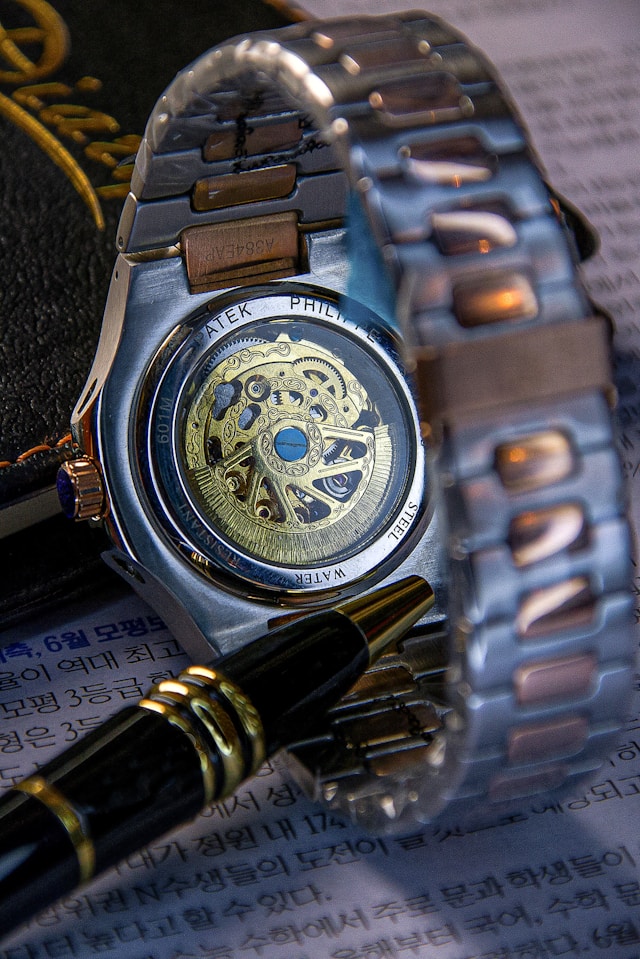
    Close-up of a Patek Philippe showing its intricate movement through a transparent caseback, surrounded by a silver metal bracelet and a black pen resting on paper with text.
    Photo showing the caseback by Hammad Zaheer on Unsplash
    ComponentRoleEnthusiast Tips
    Mid‑caseMain metal shell (steel, titanium, bronze).Look for drilled lug holes & bevelled edges for comfort.
    CasebackSeals the movement. Solid backs allow engraving; sapphire display backs satisfy movement voyeurs.Transparent backs add ≈1 mm thickness & can compromise magnetism shielding.
    GasketsO‑rings of rubber or PTFE in crown, crystal, pushers, caseback.Replace every 2–3 years if you swim frequently.
    Helium ValveNiche to saturation‑diving watches.Useless to 99 % of wearers—consider it a flex.


    4. Dial & Hands—The Interface

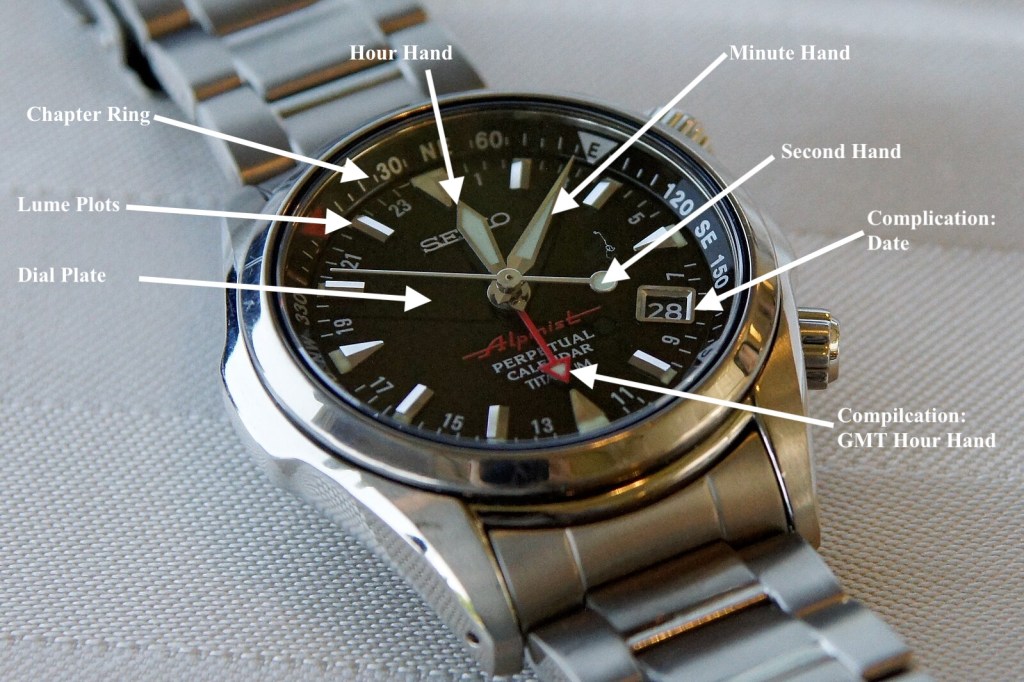
    Close-up of a watch face displaying hour, minute, and second hands, along with features like lume plots, dial plate, chapter ring, and complications such as date and GMT hour hand.
    Modified from “Seiko Prospex Alpinist,” via Wikimedia Commons, licensed under CC BY-SA 4.0.

    The dial is the face of the watch, where time is displayed and complications are showcased. It serves as the primary interface between the watch and its wearer, combining both function and style.

    Dial Plate: The main surface of the dial, typically made from brass or German silver, then coated, printed, or enamelled for color and texture. This is where the hour markers, brand logo, and other visual elements are applied.

    Hands: The moving pointers that indicate hours, minutes, and seconds. Often made from lightweight metal, they come in various shapes, from sword hands to dauphine or skeletonized designs.

    Rehaut/Chapter Ring: The angled ring surrounding the dial, often used for minute tracks or depth markers. It provides a sense of depth to the watch and can be engraved or printed with additional markings. Read more here.

    Lume Plots: Small, often raised dots or lines filled with luminous material like Super-LumiNova, designed to glow in the dark for improved legibility.

    Complications: Additional functions beyond just displaying hours and minutes. Common examples include date windows, chronograph sub-dials, moon phase indicators, and power reserve meters.


    5. Under‑The‑Hood Add‑Ons—Beyond the “101” Movement

    Close-up image of a watch movement showcasing intricate gears and a gold-plated rotor labeled 'Stowa Twenty-Five 25 Jewels Swiss Made'.
    ETA 2824 movement, via Wikimedia Commons, licensed under CC BY-SA 2.0.

    While Movements 101 covered power, transmission, and regulation, three supporting parts deserve a cameo here:

    1. Rotor (automatic only): A semicircular weight that swings 360°, winding the mainspring in one or two directions. Adds about 1 mm height but saves you daily hand winding.
    2. Bridges & Plates: The movement’s “skeleton”—bridges hold gears; the main‑plate anchors everything. Haute horlogerie brands skeletonise bridges for art and weight savings. Read more here.
    3. Shock Protection (Incabloc/KIF): Spring‑mounted jewel settings let the balance staff flex during impact, boosting durability. Read more here.


    6. Straps, Bracelets & Closures

    • Bracelet (metal): Links + solid end links (SELs) + clasp. Look for screws, not friction pins.
    • Strap (leather, rubber, fabric): Quick‑release spring bars are a boon for daily wearers.
    • Clasp types: Tang buckle (traditional), deployant (folding), micro‑adjust clasp (on‑the‑fly comfort).

    Hot‑take: A $20 well‑matched NATO strap can elevate a $500 micro‑brand better than a rattly stock bracelet.


    7. Bringing It All Together—Why This Matters

    Understanding the outer anatomy lets you:

    1. Diagnose: If your watch crystal fogs up, it’s not necessarily a movement issue—it’s more likely a gasket failure allowing moisture in. Knowing this saves you from unnecessary panic or costly movement repairs.
    2. Buy smarter: When buying a watch, it’s crucial to understand why certain features (like a ceramic bezel or a sapphire caseback) increase the price. It’s not just about aesthetics; these materials offer superior durability and scratch resistance, justifying the investment.
    3. Maintain: A gritty feeling when winding or setting your watch could indicate dirt or wear inside the screw-down crown tube. Getting it serviced early prevents water ingress, which could otherwise damage the movement you learned about earlier.

    Your watch isn’t a black box; it’s an ecosystem where every screw and gasket plays its part. Recognise the synergy, and routine time‑checks become moments of appreciation.


    Further Learning

    🎥 Video pick: “A Complete Guide to the Parts of a Watch

    Just like the 101 part 1, I’m sharing a video to that helps you visualize the components that you just reviewed.


    Share & Subscribe

    If this deep dive made you look at your wrist differently, share the post and subscribe to Mechanical Minutes for more no‑nonsense horology every week.


    Stay ticking!


  • Why Another Watch Blog?

    Why Another Watch Blog?

    A personal origin story and what you’ll find here


    An itch that started with my grandfather’s HMT

    I was eight when my grandfather slipped off his HMT Rajat, pried open the case‑back with a battered pen‑knife, and showed me the oscillating rotor. “It powers itself as long as you keep moving,” he said, half professor, half magician.

    That tiny swinging weight—no batteries, no screens—hooked me for life. The allure wasn’t price or prestige; it was engineering poetry you could wear.


    Fast‑forward to adulthood: tech life, restless hands

    By day I’m a tech consultant untangling cloud architectures and spaghetti code. The work is cerebral, digital, ephemeral. Watches became my analog counterweight—gears you can actually hear ticking after a day full of Slack pings.

    In the past few years I doubled‑down on the hobby because:

    1. Depth – Horology is an endless rabbit‑hole: movements, finishing, micro‑brands, history.
    2. Mindfulness – Winding a mechanical watch each morning is a 10‑second meditation.
    3. Community – Nothing sparks conversation like spotting a familiar dial across a conference table.

    I’ve already infected my wife, brother, and a couple of colleagues with the bug. This blog is simply the next, inevitable spiral: learn more together and pay forward what I pick up.


    “Spend less than you make, and invest the rest”

    Morgan Housel hammers this idea throughout The Psychology of Money:

    “Spending money to show people how much money you have is the fastest way to have less money.” — TPoM, Chap. 7

    That resonates. I earn a decent living but prefer value over flex—which is why you’ll see me index more on affordable watches under 2K. It’s a sweet spot where craftsmanship meets pragmatism; wealth you don’t see belies the real flex. That doesn’t mean that I don’t drool over the more expensive timepieces, which I’m sure most of my readers do as well. So, I’ll surely create content spotlighting such watches, their brands and the history behind them.


    My first “serious” watch: Sinn 104 St SA

    Last year my wife surprised me with a Sinn 104. It nails everything I love:

    • Tool‑watch toughness
    • Day‑date complication (beats checking a screen)
    • Design that toggles between boardroom and barbecue

    It also proved you don’t need a Swiss marquee to own a lifetime piece—another ethos you’ll see here.


    But … didn’t you ditch the Apple Watch?

    Yup. I wanted less beeping on my wrist.

    Problem: I still need health metrics and multiple time‑zones (family in India, clients worldwide).

    Solution:

    • Oura Ring Gen 3 for covert fitness tracking (battery lasts a week; no glowing rectangle).
    • A rotating roster of mechanical watches with use‑case complications: GMT hand when traveling, day‑date for office cadence, timing bezel for workouts.

    Call it digital minimalism with analog flair—and yes, it squares with the cost‑conscious mantra because the ring replaces annual smart‑watch churn.


    What to expect from this blog

    1. Plain‑English explainers – Movements, servicing, water resistance, lume, you name it.
    2. Curated watch reviews – Always under $2 k, with real‑world wear tests.
    3. History & stories – From HMT’s role in post‑Independence India to Sinn’s aviation roots.
    4. Buying used, safely – Marketplaces, red‑flags, and negotiation scripts.
    5. Money matters – Total‑cost‑of‑ownership calculators and “buy once, cry once” spreadsheets (coming soon).
    6. Interviews & community spotlights – Everyday collectors, not just influencers.

    How you can dive in right now

    • Subscribe to the newsletter (form in the sidebar).

    Thanks for stopping by—wind your watch, stay curious, and let’s demystify mechanical timepieces together.


    Next up: “Mechanical vs. Quartz vs. Automatic—A 5‑Minute Primer.” Stay tuned.