A quick, 5-minute read to keep your timepiece ticking for decades.
1. Skipping the Post-Swim Rinse
❌ Mistake: Assuming “water-resistant” means “chlorine-proof.”
⚙️ Fix: After every swim—pool or ocean—rinse under cool tap water, pat dry, then air-dry crown-down. Salt and chemicals eat gaskets fast.
2. Setting the Date Between 9 p.m. – 3 a.m.
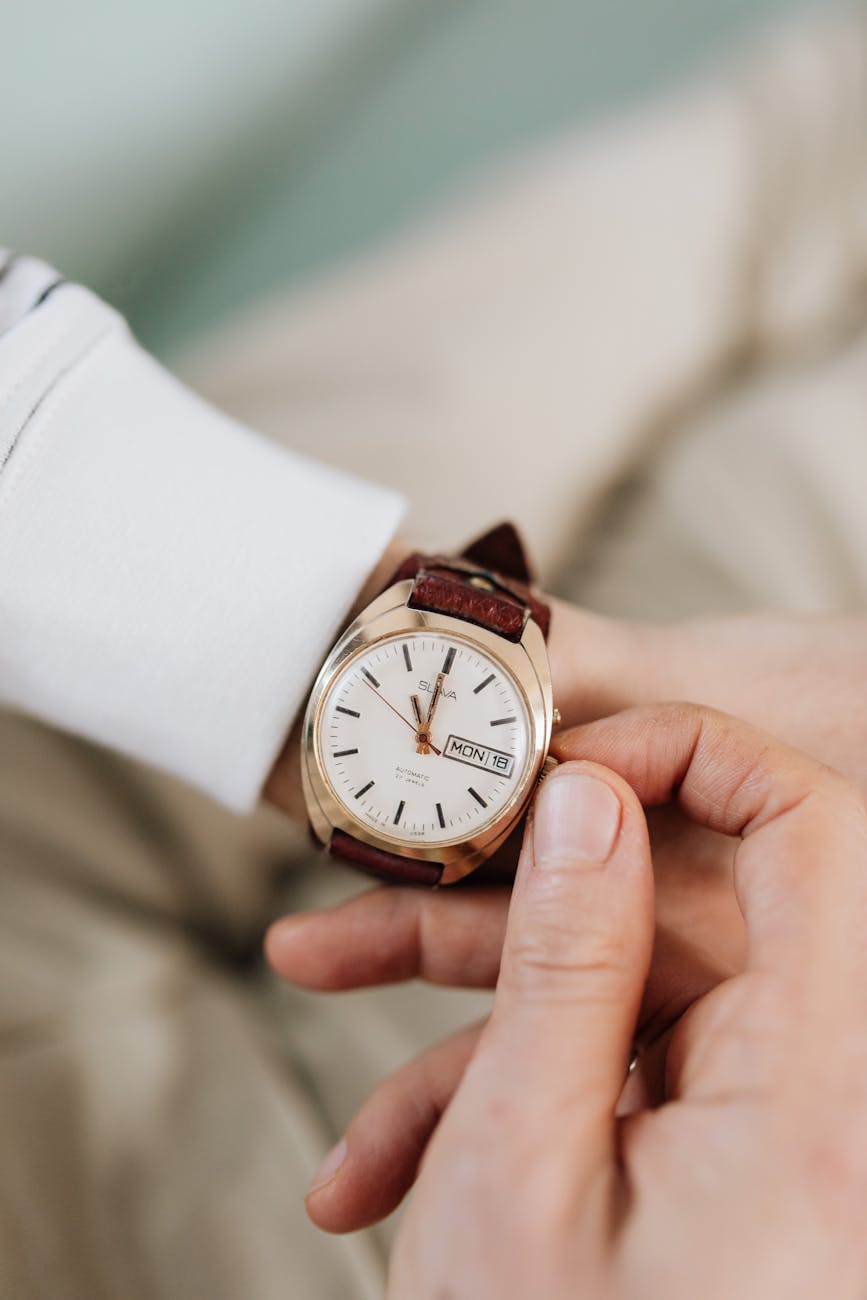
❌ Mistake: Adjusting the date while the date-change gears are engaged.
⚙️ Fix: Pull the crown to time-setting, move hands past 3 a.m., then set the date. Zero stripped gears, zero drama.
3. Over-Winding Manuals & Under-Winding Autos
❌ Mistake: Cranking a manual until it squeaks—or never giving an automatic its 30–40 crown turns after downtime.
⚙️ Fix: Stop winding manuals the moment you feel resistance. For autos at rest, give 30 smooth crown turns before wearing.
4. Ignoring Yearly Pressure Tests on “Water-Resistant” Quartz
❌ Mistake: Believing quartz gaskets last forever.
⚙️ Fix: Pressure-test every 12–18 months if you shower or swim with it. A $30 test beats a $300 movement swap.
5. Leaving Crowns or Pushers Un-Screwed
❌ Mistake: Forgetting to screw-down the crown, or pressing chrono buttons underwater.
⚙️ Fix: Ritualize it—wind, set, screw-down. Keep hands off pushers unless the watch is clearly rated for it (200 m+).
6. Storing on a Hot Dashboard or in Direct Sun
❌ Mistake: Heat bakes lubricants and fades dials.
⚙️ Fix: Use a shaded drawer or travel roll. In a car, glovebox > dashboard.
7. Magnetizing Your Movement
❌ Mistake: Parking the watch near laptop speakers, phone mags, or magnetic bag clasps.
⚙️ Fix: Keep watches 15 cm / 6 in away. Second hand stuttering? A $20 demagnetizer fixes it in 10 sec.
8. DIY Strap Changes Without Tape or a Spring-Bar Tool
❌ Mistake: Prying with a knife and scarring the lugs.
⚙️ Fix: Spend $10 on a spring-bar tool and cover lugs with painter’s tape. Two minutes of prep = zero resale-killing scratches.
9. Letting Automatics Sit Dead for Weeks
❌ Mistake: Repeatedly draining the power reserve to zero.
⚙️ Fix: If unworn > 3 weeks, give a full wind monthly or use a low-TPD winder. Lubes stay fluid; accuracy stays tight.
10. Skipping the 5-Year Full Service
❌ Mistake: Waiting until the watch runs slow—or stops.
⚙️ Fix: Budget an overhaul every 4–6 years (clean, oil, regulate, new seals). Cheaper than replacing a worn escapement later.
Quick-Reference Cheat Sheet
✅ Do This
🚫 For Avoiding This
Rinse after swimming
Chlorine / salt buildup
Wind manuals until resistance
Over-cranking
Set date outside 9 p.m.–3 a.m.
Stripping date gears
Tape lugs before strap swaps
Lug scratches
Pressure-test yearly if you swim
Silent gasket failure
Final Thoughts
Mechanical or quartz, a wristwatch is a miniature machine enduring 100+ million vibrations a day. Respect the tolerances, and it will outlive you; abuse them, and it becomes a paperweight. Follow the checklist above, and you’ll spend more time enjoying your watch than explaining repair invoices.
🚀 Keep Learning
Subscribe to Mechanical Minutes for deep dives into calibres and affordable watch picks.
Got a horror story? Share your biggest maintenance mistake in the comments—help the next enthusiast avoid it!
Whether you’re buying a desk-diver or a saturation-ready diver’s tool, that little “50 m,” “10 bar,” or “300 m” on the dial is easy to misread. Below is a guide that demystifies laboratory ratings, explains why depth ≠ real-world use, and shows exactly which activities each rating can (and can’t) handle.
1. How Watchmakers Test Water Resistance
Term on Watch
What It Actually Refers To
Typical Test Method
Meters (m)
Static depth in still, room-temperature water.
Pressure chamber gradually pressurized to equivalent depth, held for ~10 min.
Bar / Atmospheres (ATM)
1 bar ≈ average sea-level atmospheric pressure (14.5 psi).
Same chamber test; 10 bar = 100 m, 20 bar = 200 m, etc.
Key point: Tests are static—the watch simply sits there in a chamber. Real-world activities (swimming strokes, faucet jets, sudden temperature swings) create dynamic pressure spikes far higher than the label suggests.
2. Depth Ratings vs. Real-Life Water Sports
Rating
Casual Hand-Washing & Rain
Shower
Swimming Pool
Snorkeling, Kayaking, Water-Skiing
Recreational Scuba (≤40 m)
30 m / 3 bar
✅
⚠️ Steam & soap can sneak past gaskets
❌
❌
❌
50 m / 5 bar
✅
✅ Avoid hot sprays
✅ Easy laps ⚠️ Vigorous laps
❌
❌
100 m / 10 bar
✅
✅
✅ Vigorous laps
✅ Snorkeling, kayaking, water-skiing
⚠️ Risky
200 m / 20 bar
✅
✅
✅
✅
✅ Recreational scuba
300 m+ / ISO 6425 Diver’s
✅
✅
✅
✅
✅ All air-tank diving
*Why “⚠️” at 100 m? Laboratory 10 bar tests don’t simulate the rapid pressure changes, water impact, and prolonged immersion of scuba. Unless your watch also states “Diver’s 100 m” (ISO 6425), stick to snorkeling or shallower fun.
3. Why 100 m Isn’t Automatically “Scuba-Safe”
Dynamic pressure spikes – A freestyle arm pull can momentarily multiply pressure by 3-5×.
Thermal shock – Jumping from a hot deck into 20 °C water shrinks seals.
Long dwell time – A 40-minute dive keeps gaskets under load far longer than a 10-minute lab test.
ISO 22810 vs. ISO 6425 – Most watches only meet the general-purpose ISO 22810 guideline (formerly “Water-Resistant”). ISO 6425 adds vibration, salt-fog, shock, temperature-cycle, and 25 % extra pressure margin tests—then allows the “Diver’s” label.
ISO 6425 certified; readable in dark, unidirectional bezel, antimagnetic, etc.
Open-water diving, PADI class watch.
“Diver’s 300 m with HeV”
Built for saturation work; helium-escape valve.
Commercial bell diving, mixed gas, professional tool watch realm.
5. Care & Maintenance Tips
Rinse after salt or chlorine – Prevent gasket-eating crystal deposits.
Avoid hot tubs – Heat + chemicals accelerate seal fatigue.
Service the seals – Manufacturers recommend pressure tests every 1-2 years if you actually swim.
Crown discipline – Screw it down firmly before touching water, never under it.
Don’t test fate – If the watch is sentimental or vintage, treat the rating as historical fiction.
6. Myth-Busting Quick Hits
“My 100 m watch survived a 50 m dive, so it’s fine.” Maybe today—gaskets age.
“30 m watches leak only if defective.” Regular shower heat alone can defeat them.
“Helium valves are marketing fluff.” Not if you live in a saturation chamber for days; otherwise, yes, mostly bragging rights.
8. Bottom Line
Water-resistance markings are guides, not guarantees. Treat a 50 m watch as a pool buddy, a 100 m as a snorkel pal, and a Diver’s 200 m as your scuba wingman. Anything less? Keep it high and dry—or at least above the splash line.
Stay ticking!
Share & Subscribe
If this deep dive made you look at your wrist differently, share the post and subscribe to Mechanical Minutes for more no‑nonsense horology every week.
A mechanical watch stores energy in its mainspring. Keeping that spring in its ideal tension “sweet spot” (roughly the first 70-80 % of its power reserve) lets the balance wheel swing with consistent amplitude, which is what keeps time reliably. Winding correctly therefore isn’t just about avoiding damage—it’s about day-to-day accuracy.
1. Know What’s on Your Wrist
Movement type
Typical power-reserve (hrs)
Clutch to stop overwind?
Best practice
Manual-wind (e.g., ETA 6497)
38–50
No – you can force breakages
Wind once a day at the same time
Modern hand-wind (e.g., Peseux 7001)
42–55
No
Wind until resistance, stop
Automatic (e.g., ETA 2824, Miyota 9000)
38–70
Yes – slipping bridle
30–40 crown turns after a full stop, then rely on wrist wear
2. When Should You Wind?
Manual watches: every morning before you strap it on. A daily routine prevents the amplitude dip that creeps in as the spring relaxes.
Automatics you don’t wear daily: give them a 30-40-turn “top-off” once a week or whenever they’ve stopped. Doing so resets the power reserve and the lubricants inside stay evenly distributed.
3. The Safe Winding Routine (Step-by-Step)
Take the watch off your wrist – avoids lateral pressure on the stem.
Unscrew the crown (if it’s a screw-down) to position 0.
Turn the crown clockwise in smooth, quarter-turn flicks.
Manual: expect 20-40 turns; resistance will grow steadily.
Automatic: expect a soft “whir” and little resistance at first.
Stop the instant you feel firm resistance – that is the spring at full tension. For automatics the bridle will slip silently beyond this point, but continuing serves no purpose.
Push / screw the crown back in to maintain water-resistance.
4. “Overwinding” — Myth vs Reality
Manual: Forcing past the stop can shear the arbor or snap the mainspring. That’s true overwinding.
Automatic: The slipping bridle means you cannot overwind in normal use. You can still break the stem or crown if you crank excessively hard.
Rule of thumb: Resistance = Stop. Any grinding, squeaking or sudden looseness warrants a watchmaker’s inspection.
5. Accuracy Tips
Stay topped-up: A fuller mainspring keeps the balance amplitude steadier, improving rate stability by 3–6 s/day on many calibres.
Avoid partial winds: Chasing a “few quick turns” multiple times a day creates uneven torque curves. One full wind is better than three half-winds.
Consistent posture: Wind at roughly the same time and position (crown pointing down) to minimise lubricant migration.
Service on schedule: Dried or displaced lubricants are the #1 culprit for erratic amplitude, not overwinding.
6. Quick-fire FAQ
Can I wind backward? Not needed. Most modern movements disengage in reverse but some vintage pieces don’t—avoid unnecessary wear.
How many turns is “full”? Your manual is king, but 25–35 is common. Stop at resistance.
Daily winding hurts the crown threads, right? Not if you’re gentle and keep the tube gasket lubricated at each service interval.
Should I buy a winder? Only if you have many automatics with complications (perpetual calendar, etc.). Otherwise, a manual top-off is simpler.
Take-away
Winding a mechanical watch correctly boils down to three habits:
Off-wrist, smooth clockwise turns.
Stop at first firm resistance.
Keep a consistent daily routine.
Master those, and you’ll protect your mainspring, keep time accurately, and enjoy that satisfying crown-click for decades to come.
Watch & Learn — Helpful YouTube Walk-throughs
1. How to wind an automatic watch
2. Automatic Movement Best Practices. Proper Winding, Helicopter Rotor, Movement Longevity.
Stay ticking!
Share & Subscribe
If this deep dive made you look at your wrist differently, share the post and subscribe to Mechanical Minutes for more no‑nonsense horology every week.
A natural follow‑up toWatch Movements 101 Pt 1—this guide steps outside the movement to explore every visible (and a few hidden) components that make your watch look, feel, and perform the way it does.
1‑Minute Recap of Pt 1
In Watch Movements 101Pt 1 we dug into the engine room—mainspring, gear train, escapement, balance wheel, and fine regulation. Today we zoom out to the chassis and bodywork that protect and showcase that engine:
Interface elements (dial, hands, lume, pushers, strap/bracelet & clasps)
Supporting cast (jewels, rotor, bridges & plates—how they tie into the case)
Goal: After this 5‑7 minute read, you’ll glance at a watch and instantly recognize why every detail exists, not just what it is.
2. Surface Essentials—What You Touch & See First
2.1 Crystal
A watch crystal is the transparent shield that keeps dust, moisture, and a life of knocks away from the dial. The scratch resistance of watch crystal is measured using the Mohs scale, with 1 being the softest (for example, talc, which can be easily scratched using a fingernail) to the highest being 10 (diamond). Commonly used materials: • Sapphire (9 Mohs): Almost scratch‑proof; premium divers and luxury pieces. • Mineral glass (≈5 Mohs): Hardened but affordable; easy to replace. • Acrylic (≈3 Mohs): Vintage charm, cheap, can be polished; shatters less dangerously (no prickly shattered pieces).
The crown is the command centre: wind, set, hack, or change modes. Screw‑down designs and twin gaskets safeguard water resistance. Chronographs add pushers—plunger buttons—usually at 2 & 4 o’clock. Photo by John Torcasio on Unsplash – Free to use.
2.4 Lugs & Spring Bars
Lugs are the horns that accept spring bars, letting straps swap easily. Shorter, downward‑curving lugs wear smaller; drilled lug holes speed up strap changes.
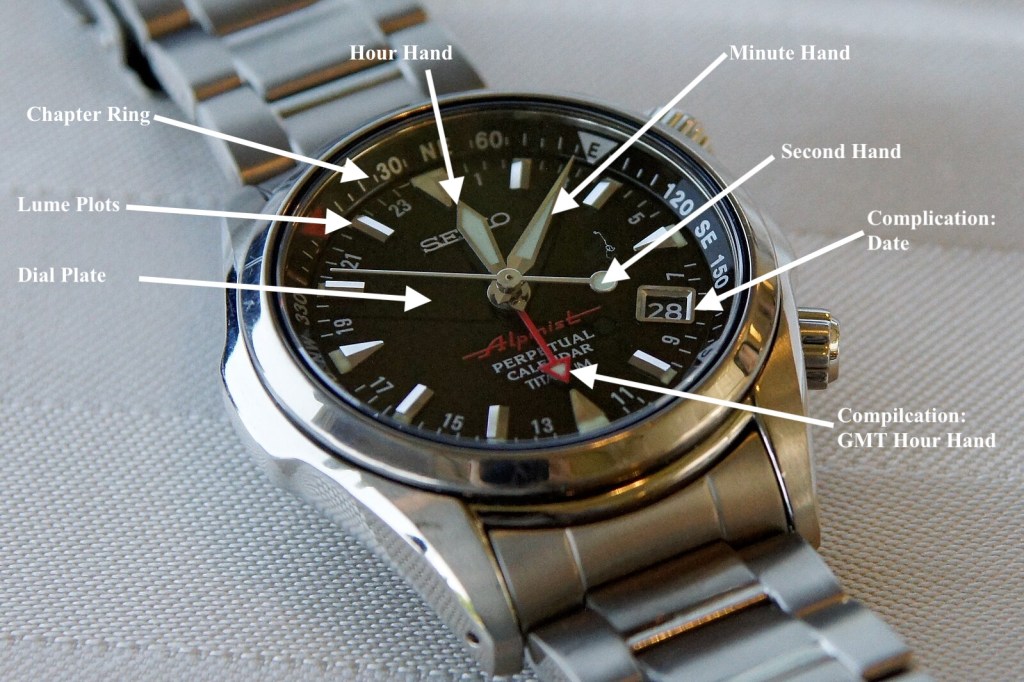
The dial is the face of the watch, where time is displayed and complications are showcased. It serves as the primary interface between the watch and its wearer, combining both function and style.
Dial Plate: The main surface of the dial, typically made from brass or German silver, then coated, printed, or enamelled for color and texture. This is where the hour markers, brand logo, and other visual elements are applied.
Hands: The moving pointers that indicate hours, minutes, and seconds. Often made from lightweight metal, they come in various shapes, from sword hands to dauphine or skeletonized designs.
Rehaut/Chapter Ring: The angled ring surrounding the dial, often used for minute tracks or depth markers. It provides a sense of depth to the watch and can be engraved or printed with additional markings. Read more here.
Lume Plots: Small, often raised dots or lines filled with luminous material like Super-LumiNova, designed to glow in the dark for improved legibility.
Complications: Additional functions beyond just displaying hours and minutes. Common examples include date windows, chronograph sub-dials, moon phase indicators, and power reserve meters.
5. Under‑The‑Hood Add‑Ons—Beyond the “101” Movement
While Movements 101 covered power, transmission, and regulation, three supporting parts deserve a cameo here:
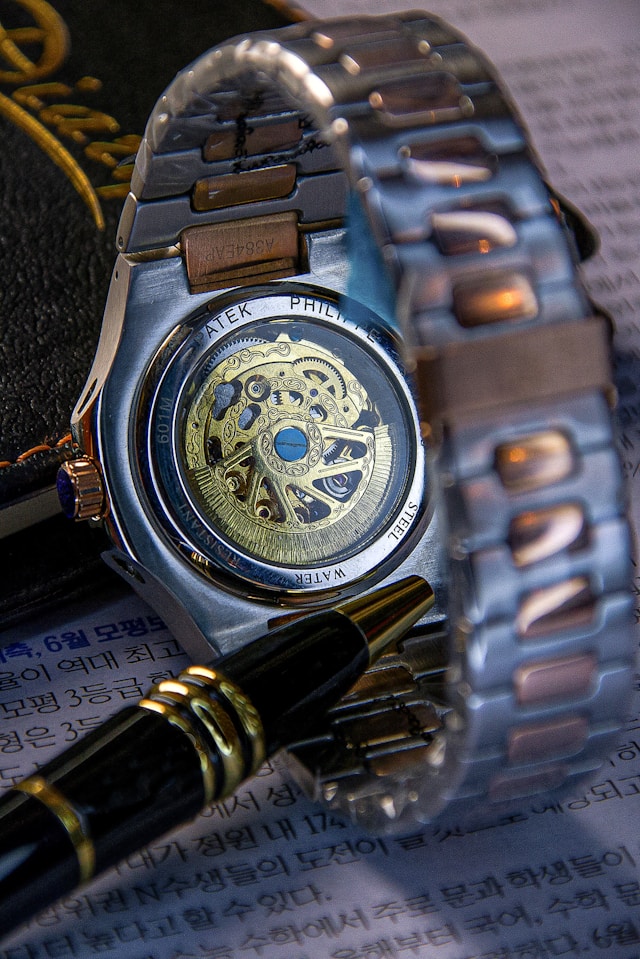
Rotor (automatic only): A semicircular weight that swings 360°, winding the mainspring in one or two directions. Adds about 1 mm height but saves you daily hand winding.
Bridges & Plates: The movement’s “skeleton”—bridges hold gears; the main‑plate anchors everything. Haute horlogerie brands skeletonise bridges for art and weight savings. Read more here.
Shock Protection (Incabloc/KIF): Spring‑mounted jewel settings let the balance staff flex during impact, boosting durability. Read more here.
6. Straps, Bracelets & Closures
Bracelet (metal): Links + solid end links (SELs) + clasp. Look for screws, not friction pins.
Strap (leather, rubber, fabric): Quick‑release spring bars are a boon for daily wearers.
Hot‑take: A $20 well‑matched NATO strap can elevate a $500 micro‑brand better than a rattly stock bracelet.
7. Bringing It All Together—Why This Matters
Understanding the outer anatomy lets you:
Diagnose: If your watch crystal fogs up, it’s not necessarily a movement issue—it’s more likely a gasket failure allowing moisture in. Knowing this saves you from unnecessary panic or costly movement repairs.
Buy smarter: When buying a watch, it’s crucial to understand why certain features (like a ceramic bezel or a sapphire caseback) increase the price. It’s not just about aesthetics; these materials offer superior durability and scratch resistance, justifying the investment.
Maintain: A gritty feeling when winding or setting your watch could indicate dirt or wear inside the screw-down crown tube. Getting it serviced early prevents water ingress, which could otherwise damage the movement you learned about earlier.
Your watch isn’t a black box; it’s an ecosystem where every screw and gasket plays its part. Recognise the synergy, and routine time‑checks become moments of appreciation.
Further Learning
🎥 Video pick: “A Complete Guide to the Parts of a Watch”
Just like the 101 part 1, I’m sharing a video to that helps you visualize the components that you just reviewed.
Share & Subscribe
If this deep dive made you look at your wrist differently, share the post and subscribe to Mechanical Minutes for more no‑nonsense horology every week.